Roberto Martínez announced his 26-man Portugal squad for the FIFA World Cup 2026 on May 19 — and in a selection loaded with emotional weight, tactical surprises, and one record-breaking inclusion, the Nations League champions head to North America as one of the most complete squads in the tournament.
Cristiano Ronaldo, at 41, will play in his sixth World Cup. And Martínez has made several bold calls — four goalkeepers, a midfielder listed at centre-back, and notable omissions — that tell you exactly how the Spaniard plans to approach the biggest test of his international career.
From a record that may never be broken to a tribute that captured the football world’s attention, here are the five biggest talking points from the Portugal squad for World Cup 2026.
ALSO READ: FIFA World Cup 2026 Squads: All Teams, Players and Announcement Dates
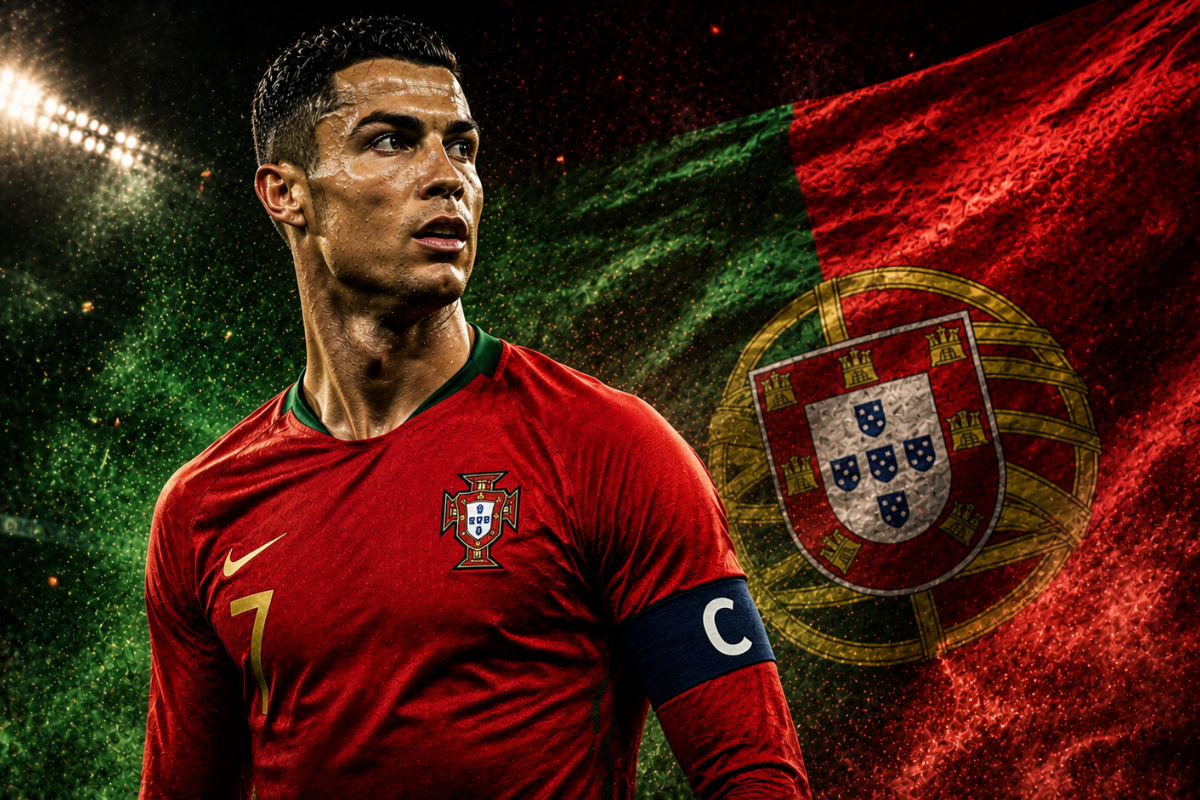
Cristiano Ronaldo At 41 — A Sixth World Cup And The Record That Defines An Era
The headline is unavoidable. Cristiano Ronaldo will play at his sixth FIFA World Cup, becoming only the second male outfield player in history — alongside Lionel Messi — to reach that milestone. He first appeared at a World Cup in 2006. Twenty years later, he is still leading the line.
The numbers remain absurd for a 41-year-old. Ronaldo has scored 28 goals for Al-Nassr this season and sits on 143 international goals from 226 caps, both all-time records for a male footballer. He netted five times during Portugal’s World Cup qualifying campaign, finishing as the team’s top scorer. The goals have not dried up. The question is whether they translate to tournament football at this level.
Martínez has navigated this carefully. Ronaldo missed the March friendlies through a hamstring injury, and there has been open discussion about whether his role should shift from guaranteed starter to impact option. The Cristiano Ronaldo injury update ahead of the tournament confirmed he recovered fully, but managing his workload across three group games and a potential knockout run will be one of the defining tactical challenges of Portugal’s summer.
The World Cup remains the one trophy that has eluded Ronaldo throughout his career. He has never scored a knockout-stage goal at the tournament. He has reached the semi-finals only once, in 2006. This is almost certainly his last chance. Whether it ends in glory or heartbreak, the fact that he is still here — still selected, still scoring, still demanding the ball — is a testament to a career that refuses to follow the normal rules of decline.
The PSG Spine — Four Club Teammates Forming Portugal’s Core
No national team at the FIFA World Cup 2026 is as reliant on a single club’s core as Portugal are on Paris Saint-Germain. Vitinha, João Neves, Nuno Mendes, and Gonçalo Ramos all play together at PSG — and three of those four are likely to start for Martínez in North America in the Portugal squad for World Cup 2026.
That kind of club-level chemistry is a genuine competitive advantage. Vitinha and João Neves have built one of the most effective midfield partnerships in European football over the past two seasons, helping PSG win the Champions League in 2025. They understand each other’s positioning, pressing triggers, and passing patterns instinctively. Adding Nuno Mendes on the left, who overlaps and underlaps with the same timing he uses at club level, gives Portugal’s left side a fluency that most international teams spend weeks trying to manufacture during pre-tournament camps.
Gonçalo Ramos, meanwhile, offers Martínez a ready-made alternative to Ronaldo. The PSG striker scored a hat-trick against Switzerland at the 2022 World Cup as a starter in the round of 16 — a game Ronaldo was dropped for. If Martínez chooses to rest Ronaldo or shift to a more mobile front line for specific opponents, Ramos slots in without disrupting the rest of the system.
The risk is the same risk that comes with any club-heavy selection: if PSG’s season ended with fatigue or tactical staleness, that carries over into the international setup. But on balance, having four players who train together daily, know each other’s movements blindly, and have won together at the highest club level is a weapon few other squads can match.
Portugal World Cup 2026 qualification scenario after Ronaldo’s historic six-tournament record
Four Goalkeepers — Martínez’s Unusual Insurance Policy
Portugal have named four goalkeepers in their 26-man squad: Diogo Costa, Rui Silva, José Sá, and Ricardo Velho. FIFA regulations require a minimum of three. Martínez has opted for the maximum defensive insurance, and it is a selection that raises tactical questions about how the rest of the squad is structured.
The decision to carry four goalkeepers means one fewer outfield player. In a tournament where squad depth is tested by three group games in eleven days, followed by a potential five knockout matches, every slot matters. Martínez has effectively sacrificed an additional midfielder or forward to guarantee goalkeeper cover in the event of injury or illness.
Diogo Costa remains the undisputed first choice. The Porto goalkeeper has been a regular since 2022 and brings experience from two major tournaments. Behind him, Rui Silva and José Sá offer proven quality. Ricardo Velho, who has no senior caps, is the development pick — a young goalkeeper brought along to train with the group and be available if disaster strikes.
The broader implication is clear: Martínez is prioritising security. In a 48-team tournament with a condensed schedule across North American venues, losing a goalkeeper to injury mid-tournament could be catastrophic. Whether the trade-off is worth it depends entirely on whether Portugal need that extra outfield body during the knockout rounds.
Matheus Nunes At Centre-Back And The Defensive Reshuffle
One of the most intriguing tactical decisions in the Portugal squad for World Cup 2026 is the listing of Manchester City’s Matheus Nunes as a defender. Nunes is a natural central midfielder who has spent the majority of his career playing in the middle of the park, but he has been used at right-back by Pep Guardiola at City and has featured in a defensive role for Portugal under Martínez in recent windows.
His inclusion in the Portugal squad in the defensive line, alongside Dalot, Nélson Semedo, João Cancelo, Rúben Dias, Gonçalo Inácio, Tomás Araújo, Renato Veiga, and Nuno Mendes, gives Martínez nine defenders — but with a twist. Nunes offers the ability to step into midfield during games, giving Portugal a hybrid option that blurs the line between a traditional back four and a midfield overload.
The defensive picture also has a notable absence. António Silva, the Benfica centre-back who was part of Portugal’s preliminary squad and had been capped at senior level, has not made the final 26. At 22, Silva was widely expected to travel as Rúben Dias’s backup. His omission suggests Martínez trusts the Gonçalo Inácio–Rúben Dias partnership with Tomás Araújo and Renato Veiga as cover — and that Nunes’s versatility provides the additional defensive numbers Martínez wants without needing a fifth specialist centre-back.
For fans tracking how other managers have built their squads this summer, our talking points from the Brazil squad for World Cup 2026 and France squad talking points cover similar selection dilemmas.
Eight Forwards And The Firepower To Win The World Cup
If the defensive structure is built on pragmatism, the attacking selection is pure ambition. Martínez has named eight forwards in the Portugal squad for World Cup 2026: Rafael Leão, Francisco Conceição, Pedro Neto, Trincão, João Félix, Gonçalo Guedes, Gonçalo Ramos, and Ronaldo.
That is an extraordinary depth of attacking talent for a nation that has never won the World Cup. Leão and Conceição offer pace and width. João Félix, still only 26 despite a career that has felt much longer, provides creativity between the lines. Trincão has been one of the standout performers in Liga Portugal this season. And Gonçalo Ramos, the PSG striker who scored a hat-trick against Switzerland at the 2022 World Cup, provides the out-and-out centre-forward alternative to Ronaldo.
The inclusion of Gonçalo Guedes in the Portugal squad is arguably the surprise. The veteran forward has been on the fringes of the squad for several years but earns a recall that pushes Portugal’s attacking options into the territory of genuine embarrassment of riches. With Pedro Neto struggling for consistent form at Chelsea, Martínez has ensured he has alternatives who can step in without any drop in quality.
The midfield, meanwhile, is arguably the strongest in the entire tournament. Bruno Fernandes enters the World Cup after a season where he challenged the Premier League assists record at Manchester United. Vitinha and João Neves form one of the best midfield partnerships in European football at PSG, where they helped win the Champions League last season. Bernardo Silva brings his usual intelligence and work rate from Manchester City. Rúben Neves and Samu Costa complete a six-man midfield group that can control possession against anyone.
According to The Sporting News’s Portugal World Cup preview, the biggest question is whether Martínez can balance Ronaldo’s presence with the creative talents around him — a challenge that will define Portugal’s tournament.
Portugal face DR Congo on June 17, Uzbekistan on June 23, and Colombia on June 28 in Group K. For the full tournament schedule and broadcast details, check our guide to FIFA World Cup 2026 broadcasting rights in every country.
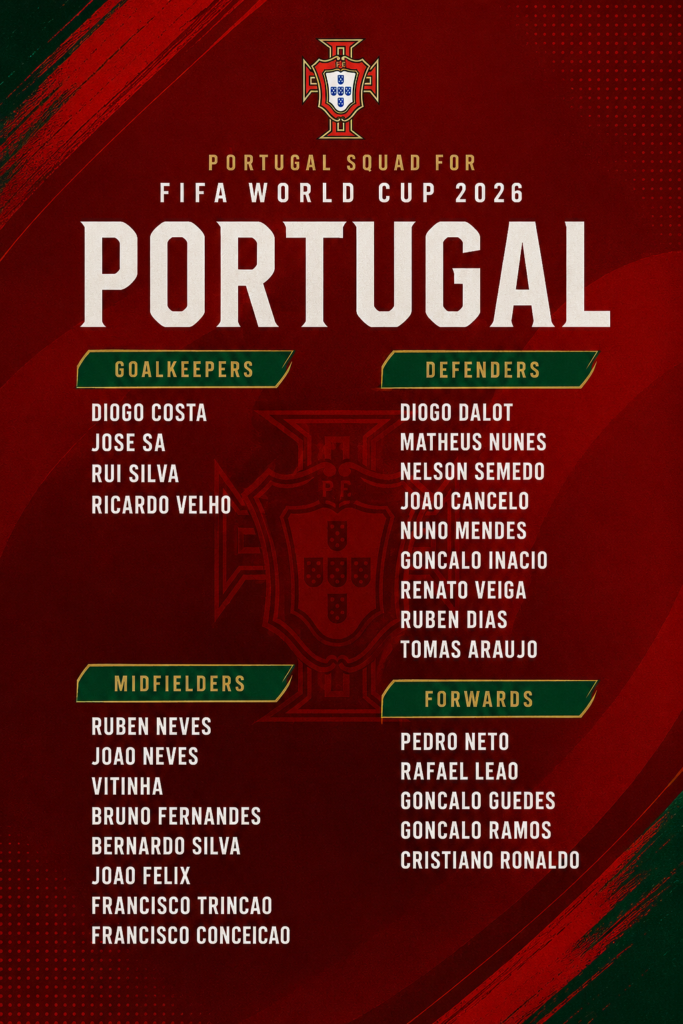
Portugal Squad For World Cup 2026 — Full List
Complete Portugal squad for the World Cup in North America.
Goalkeepers: Diogo Costa (Porto), Rui Silva (Sporting CP), José Sá (Wolverhampton), Ricardo Velho (Lens)
Defenders: Matheus Nunes (Manchester City), Dalot (Manchester United), Nélson Semedo (Fenerbahçe), João Cancelo (Barcelona), Rúben Dias (Manchester City), Gonçalo Inácio (Sporting CP), Tomás Araújo (Benfica), Renato Veiga (Juventus), Nuno Mendes (PSG)
Midfielders: Samu Costa (Mainz), Rúben Neves (Al-Hilal), Vitinha (PSG), João Neves (PSG), Bruno Fernandes (Manchester United), Bernardo Silva (Manchester City)
Forwards: Rafael Leão (AC Milan), Francisco Conceição (Juventus), Pedro Neto (Chelsea), Trincão (Sporting CP), João Félix (AC Milan), Gonçalo Guedes (Wolves), Gonçalo Ramos (PSG), Cristiano Ronaldo (Al-Nassr)
Manager: Roberto Martínez
Portugal Group K Schedule:
- June 17: Portugal vs DR Congo — NRG Stadium, Houston
- June 23: Portugal vs Uzbekistan — NRG Stadium, Houston
- June 28: Portugal vs Colombia — SoFi Stadium, Los Angeles
ALSO READ: 5 Talking Points From France Squad For World Cup 2026