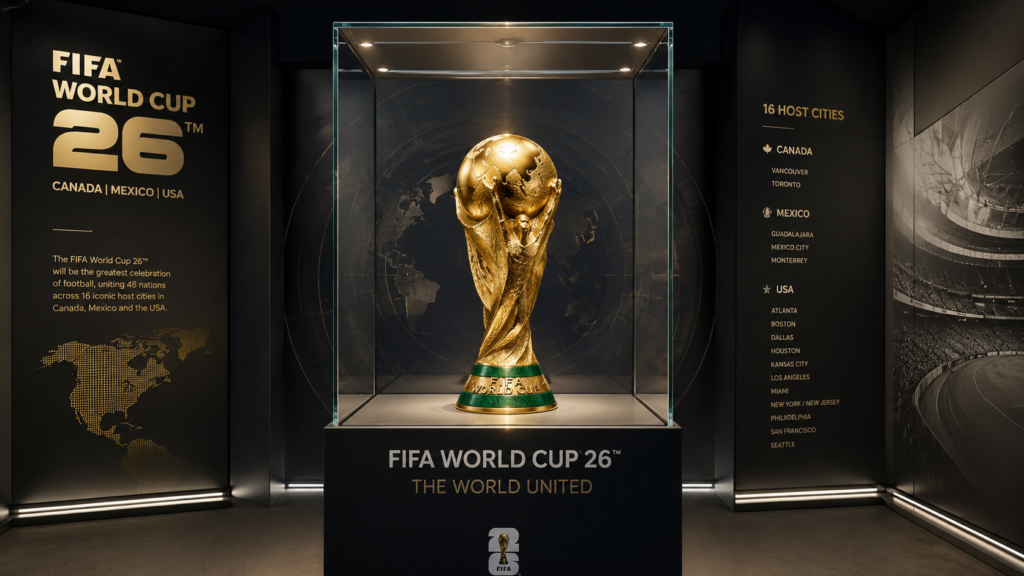
The FIFA World Cup 2026 broadcasting rights landscape is unlike anything fans have seen before a major tournament. With 104 matches spread across the United States, Canada and Mexico from June 11 to July 19, FIFA has closed broadcast deals in more than 175 territories worldwide. All FIFA World Cup 2026 squads were confirmed by June 2. India and China — the planet’s two most populous nations — secured broadcasters only in the final weeks before kickoff, with India’s Zee Entertainment signing just ten days before the opener on June 11. This guide covers every confirmed FIFA World Cup 2026 TV channel, live streaming platform and where to watch the biggest football tournament in history, country by country.
The expanded 48-team format means more matches, more simultaneous broadcast windows and a more complex web of World Cup 2026 broadcast rights than any previous edition. FIFA has earned close to four billion dollars from broadcasting revenue in this cycle alone, with rights sold territory by territory rather than through a single global package. For fans, that means the answer to “where can I watch?” changes depending on where you live, what language you prefer and whether you watch on television, a streaming app or your phone.
ALSO READ: FIFA World Cup 2026 round of 8 schedule — dates, kick-off times, and venues
(updated on July 6, 2026)
Table of Contents
FIFA World Cup 2026 Broadcasting Rights In India — Zee Entertainment Secures Late Deal
The most dramatic subplot in the entire FIFA World Cup 2026 broadcasting rights saga played out in India — and was resolved just ten days before kickoff. On June 1, Zee Entertainment Enterprises Limited signed a landmark long-term agreement with FIFA, securing exclusive broadcasting and digital rights for the tournament in India.
The deal covers 39 FIFA events over eight years through 2034, including the 2026 and 2030 Men’s World Cups and the 2027 Women’s World Cup. Financial terms were not officially disclosed, but reports indicate the deal was struck at approximately $30–35 million — far below FIFA’s original asking price of $100 million for the bundled 2026/2030 package, and below the reduced $60 million figure that was initially floated.
Indian fans can watch every match of the FIFA World Cup 2026 across Zee’s television and digital platforms:
TV Channels:
- Unite8 Sports 1 (Hindi commentary) — ₹7/month before taxes
- Unite8 Sports 1 HD (Hindi) — ₹9/month
- Unite8 Sports 2 (English commentary) — ₹8/month
- Unite8 Sports 2 HD (English) — ₹11/month
- Zee Cinema — overflow channel for busy matchdays with simultaneous fixtures
- Zee Bangla Sonar — Bengali commentary
- Zee Keralam — Malayalam commentary
Live Streaming:
- ZEE5 — All matches live with an active ZEE5 Premium subscription. A three-month sports plan is priced at ₹799, covering the entire World Cup period. An annual premium plan is also available for fans seeking broader entertainment content beyond football.
The Delhi High Court granted Zee an anti-piracy injunction on June 3, restraining several websites — including Soccerbox, DLHD, Strumyk, and Sportsbay — from illegally streaming tournament matches.
The standoff that preceded the deal was extraordinary. FIFA launched its India media rights tender in mid-2025, bundling the 2026 and 2030 World Cups together. JioStar, the Reliance-Disney joint venture, reportedly offered $20 million — FIFA rejected it outright. Sony evaluated the opportunity but did not bid. The commercial hesitancy was driven by the North American time zones — the majority of matches kick off past midnight IST, weakening advertising value in a market where cricket properties dominate sports ad spending.
ALSO READ: World Cup 2026 semi-final schedule and kick-off times
For context, Viacom18 paid approximately $60 million for the 2022 Qatar World Cup rights and generated over ₹300 crore in advertising revenue across more than 50 brand partnerships. The Argentina vs France final alone drew 32 million digital viewers from India on JioCinema. Despite those numbers, no broadcaster stepped forward at FIFA’s initial pricing.
The deal gives Zee a significant toehold in India’s sports broadcasting market, where JioStar currently dominates with rights to the IPL, English Premier League, and other major properties. Zee shares rose approximately 7% on the day following the announcement.
ALSO READ: FIFA World Cup 2026 Squads: All Teams, Players and Announcement Dates
FIFA World Cup 2026 TV Channels And Broadcasters — Complete Country-By-Country List
FIFA sells broadcasting rights market by market, which means every country has its own unique combination of FIFA World Cup 2026 TV channels, pay-TV networks and streaming platforms. The table below covers every confirmed broadcaster across all regions. Where multiple broadcasters share coverage in a single territory, all confirmed partners are listed.
North America
| Country | TV Channel(s) / Broadcaster | Streaming / Digital | Notes |
|---|---|---|---|
| United States (English) | FOX, FS1 | FOX One, Fox Sports App, FuboTV, YouTube TV, Hulu Live | All 104 matches; select matches in 4K |
| United States (Spanish) | Telemundo, Universo | Peacock | Full tournament coverage |
| Canada (English) | CTV, TSN | TSN+ | — |
| Canada (French) | RDS | RDS App | — |
| Mexico | TelevisaUnivision, TV Azteca | ViX | Hosts opening match June 11 |
South America
| Country | TV Channel(s) / Broadcaster | Notes |
|---|---|---|
| Argentina | Telefe, TV Pública | Argentina matches and final on free-to-air; DSports, ESPN and Disney+ also hold regional rights |
| Brazil | Grupo Globo, SBT/N Sports | CazéTV streams all matches free on YouTube via FIFA partnership |
| Chile | Chilevisión | — |
| Colombia | Caracol, RCN, Win Sports | — |
| Ecuador | Teleamazonas | — |
| Paraguay | Trece, GEN TV, Tigo Sports | — |
| Peru | América Televisión | — |
| Uruguay | Canal 5, Antel TV | — |
| Venezuela | Televen | DirecTV Latin America also available |
| Rest of South America (regional) | DSports, ESPN, Disney+ | Covers most territories excluding Bolivia, Brazil and Paraguay for DSports |
Europe
| Country | TV Channel(s) / Broadcaster | Streaming / Digital | Notes |
|---|---|---|---|
| United Kingdom | BBC, ITV | BBC iPlayer, ITVX | Free-to-air; matches shared between both networks |
| Germany | ARD, ZDF | MagentaTV (Deutsche Telekom) | All matches on MagentaTV; extensive free-to-air sublicensing to ARD/ZDF |
| France | M6 | 6play | 54 matches free-to-air; beIN Sports holds additional rights |
| Spain | RTVE | Mediapro/DAZN | RTVE acquired rights for approximately €55 million |
| Italy | RAI | DAZN, RaiPlay | 35 matches on RAI free-to-air including opening match, both semis and final |
| Netherlands | NOS | NOS App | — |
| Portugal | Sport TV | LiveModeTV | LiveModeTV shows one match per day |
| Belgium | VRT, RTBF | — | Coverage in Dutch and French |
| Austria | ORF, ServusTV | — | — |
| Switzerland | SRG SSR | — | Multilingual coverage across SRF, RTS and RSI |
| Sweden | SVT, TV4 | — | — |
| Finland | Yle, MTV3 | — | — |
| Norway | NRK, TV2 | — | — |
| Denmark | DR, TV2 | — | — |
| Poland | TVP | — | — |
| Romania | Antena | — | — |
| Czechia | ČT, TV Nova | — | — |
| Slovakia | STVR, TV JOJ | — | — |
| Hungary | MTVA | — | — |
| Croatia | HRT | — | — |
| Serbia | RTS, Arena Sport | — | — |
| Bosnia and Herzegovina | Arena Sport | — | — |
| Montenegro | RTCG, Arena Sport | — | — |
| North Macedonia | Arena Sport | — | — |
| Slovenia | RTV SLO, Arena Sport | — | — |
| Kosovo | RTK, TV Vala, Arena Sport | — | — |
| Greece | ERT | — | — |
| Turkey | TRT | — | — |
| Ireland | RTÉ | — | — |
| Iceland | RÚV | — | — |
| Bulgaria | BNT | — | — |
| Albania | TV Klan | — | — |
| Ukraine | MEGOGO | — | — |
| Cyprus | Sigma TV | — | — |
| Estonia | TV3 | — | — |
| Latvia | TV3 Latvia | — | — |
| Lithuania | TV3 Lithuania | — | — |
| Malta | PBS | — | — |
| Israel | KAN, Charlton | — | — |
| Russia | Match TV | — | — |
Asia
| Country | TV Channel(s) / Broadcaster | Streaming / Digital | Notes |
|---|---|---|---|
| India | Unite8 Sports 1, Unite8 Sports 2, Zee Cinema | ZEE5 | Zee Entertainment secured rights June 1; Unite8 Sports 1 (Hindi), Unite8 Sports 2 (English), HD variants available; regional feeds on Zee Bangla Sonar (Bengali) and Zee Keralam (Malayalam); ZEE5 Premium subscription from ₹799 for 3 months; key matches also on DD Sports under mandatory sharing |
| China | CMG | — | Exclusive rights across all platforms; deal confirmed May 15 covering 2026 and 2030 World Cups |
| Japan | NHK, Nippon TV, Fuji TV | DAZN | NHK carries 33 matches on terrestrial TV; all matches on NHK BS Premium 4K |
| South Korea | JTBC, KBS | NAVER Sports, CHZZK | — |
| Indonesia | TVRI, RRI | — | — |
| Philippines | Aleph Group | — | — |
| Vietnam | VTV, SCTV | FPT Telecom | — |
| Singapore | Mediacorp | — | Exclusive rights |
| Cambodia | Hang Meas | — | — |
| Taiwan | ELTA, EBC, TTV | ELTA.tv, Hami Video | — |
| Hong Kong | PCCW | — | — |
| Macau | TDM | — | — |
| Mongolia | EduTV, MNB, Suld TV | — | — |
| Afghanistan | ATN (Ariana Television) | — | — |
| Iran | IRIB TV3 | — | — |
| Nepal | Acepro Media, Prime TV | — | — |
| Maldives | Medianet | — | — |
| Bangladesh | T Sports | — | Confirmed via Springbok sub-license arrangement |
| Pakistan | PTV Sports (reported) | — | Confirmed in weeks before kickoff as part of South Asian rights resolution |
| Sri Lanka | SLRC (reported) | — | Confirmed as part of FIFA’s Indian subcontinent tender resolution |
| Kazakhstan | QAZTRK, Qazsport | — | — |
| Kyrgyzstan | KTRK | — | — |
| Tajikistan | Varzish TV, TV Football | — | — |
| Turkmenistan | Turkmenistan Sport | — | — |
| Uzbekistan | Zo’r TV | — | — |
| Timor-Leste | ETO Telco | — | — |
Middle East And North Africa (MENA)
| Region / Country | TV Channel(s) / Broadcaster | Notes |
|---|---|---|
| MENA (24 countries) | beIN Sports | Exclusive rights across Algeria, Bahrain, Chad, Djibouti, Egypt, Iraq, Jordan, Kuwait, Lebanon, Libya, Mauritania, Morocco, Oman, Palestine, Qatar, Saudi Arabia, Somalia, Sudan, Syria, Tunisia, UAE, Yemen and others |
Sub-Saharan Africa
| Region / Country | TV Channel(s) / Broadcaster | Notes |
|---|---|---|
| Sub-Saharan Africa (pan-regional) | New World TV, SuperSport | SuperSport via DStv and GOtv covers approximately 50 countries; New World TV holds primary FIFA deal with local free-to-air sublicensing |
| South Africa | SABC, SportyTV | SABC secured sub-license through Hollywoodbets partnership for free-to-air access |
Oceania
| Country | TV Channel(s) / Broadcaster | Notes |
|---|---|---|
| Australia | SBS | All 104 matches live and free on SBS, SBS Viceland and SBS On Demand; Australia’s World Cup home since 1986 |
| New Zealand | TVNZ | Full exclusive coverage |
| Fiji | FBC | — |
Caribbean And Central America
| Country / Region | TV Channel(s) / Broadcaster | Notes |
|---|---|---|
| Jamaica | TVJ | — |
| Costa Rica | Teletica, Tigo Sports | — |
| El Salvador | TCS, Tigo Sports | — |
| Guatemala | Albavisión, Tigo Sports | — |
| Honduras | Televicentro, Tigo Sports | — |
| Nicaragua | Grupo Ratensa, Tigo Sports | — |
| Panama | Medcom, TVN Media, Tigo Sports | — |
Global / Travel
| Platform | Coverage | Notes |
|---|---|---|
| Sport 24 | In-flight and cruise ships | All 104 matches; available on Emirates, Turkish Airlines, Singapore Airlines, Royal Caribbean, Carnival and others |
| TikTok | Global | FIFA “preferred platform” deal; broadcasters may stream parts of matches on TikTok |
| YouTube | Global | First 10 minutes of every match streamable; CazéTV streams full matches free in Brazil |
| FIFA+ | Global | Highlights, press conferences and behind-the-scenes content; no live match coverage in territories with exclusive rights holders |
Where To Watch FIFA World Cup 2026 In The USA
The United States has the most extensive FIFA World Cup 2026 TV channels setup of any country, which makes sense given its status as the primary host nation. FOX Sports controls English-language coverage, with matches split between the main FOX network and FS1. The newly launched FOX One streaming app will carry all 104 matches live, with select games available in 4K. Fans who prefer to stream through existing services can also watch on FuboTV, YouTube TV and Hulu + Live TV, all of which carry FOX and FS1.
For Spanish-language coverage, Telemundo and Universo hold the rights, with every match also available to stream on Peacock. Tubi, the free ad-supported streaming platform owned by Fox Corporation, will stream two marquee matches free in 4K with no subscription required: Mexico vs South Africa on June 11 and USA vs Paraguay on June 12.
The USA opens its campaign on June 12 at SoFi Stadium in Inglewood, California, against Paraguay.
Where To Watch FIFA World Cup 2026 In The UK
Football fans in the United Kingdom can watch every match of the FIFA World Cup 2026 free of charge. BBC and ITV share the World Cup 2026 broadcast rights, splitting coverage across the group stage, knockout rounds and the final. This is the same partnership structure that has served British football fans for decades.
All BBC matches will stream simultaneously on BBC iPlayer, while ITV’s allocation will be available on ITVX. No subscription or pay-TV package is required to watch any match in the UK.
Where To Watch FIFA World Cup 2026 In Australia
Where to watch FIFA World Cup 2026 in Australia? SBS has been the home of World Cup football in Australia since 1986, and that continues for 2026. Every one of the 104 matches will be broadcast live and free across SBS, SBS Viceland and SBS On Demand. No pay wall, no subscription — just free-to-air coverage of the entire tournament.
World Cup 2026 group standings and qualification scenarios
FIFA World Cup 2026 Live Streaming Platforms — How To Watch Online
The rise of streaming has fundamentally changed how fans consume World Cup football, and the FIFA World Cup 2026 live streaming landscape reflects that shift. In most major markets, the official broadcaster now offers a companion streaming app alongside traditional television coverage. Here are the key digital platforms confirmed globally.
In the United States, FOX One is the primary English-language streaming home, while Peacock handles Spanish-language streams. The UK has BBC iPlayer and ITVX. Germany’s MagentaTV will carry all 104 matches digitally. In Brazil, CazéTV will stream the entire tournament free on YouTube through a dedicated FIFA partnership — a groundbreaking arrangement that marks the first time YouTube has served as the primary digital distribution platform for World Cup coverage in a major market.
FIFA has also signed two significant content platform deals. TikTok became a “preferred platform” for World Cup video content in January 2026, allowing broadcasters to stream portions of games at a dedicated hub on the TikTok app. YouTube secured a similar deal in March 2026, enabling broadcasters to stream select games in full on their YouTube channels and making the first 10 minutes of every match freely available on the platform worldwide.
FIFA+ will provide highlights, press conferences and behind-the-scenes content throughout the tournament. However, it will not carry live match coverage in territories where exclusive broadcast rights belong to a local partner — which covers virtually every major market.
Countries Where FIFA World Cup 2026 Broadcasts Were Confirmed Late
The FIFA World Cup 2026 broadcasting rights landscape saw several major markets resolved only in the final weeks before the tournament.
India was the most prominent holdout. After months of failed negotiations — with JioStar’s $20 million bid rejected and Sony declining to bid — Zee Entertainment signed a deal on June 1, just ten days before kickoff. The agreement covers 39 FIFA events through 2034 and gives Indian fans access via Unite8 Sports TV channels and ZEE5 streaming.
China ended its silence in mid-May, with China Media Group (CMG) securing exclusive rights across all platforms for the 2026 and 2030 World Cups as well as the 2027 and 2031 Women’s World Cups. CMG’s state broadcaster CCTV will carry comprehensive coverage.
Pakistan and Sri Lanka, both part of FIFA’s Indian subcontinent tender, confirmed broadcasters in the days before kickoff. Bangladesh secured coverage through T Sports via a sub-licensing arrangement.
Between them, India and China represent a combined population of approximately 2.88 billion people. The resolution of both markets before June 11 avoided an unprecedented blackout situation in World Cup broadcasting history.
How India’s Late Broadcasting Deal Came Together
India’s FIFA World Cup 2026 broadcasting deal was finalised on June 1 — making it one of the latest major-market rights agreements in World Cup history. The deal came together after months of uncertainty and required FIFA to significantly reduce its asking price from the original $100 million tender.
The breakthrough came when Zee Entertainment, which had been in advanced discussions through May, agreed to terms reportedly valued at $30–35 million. The deal was broader than just the 2026 World Cup — covering 39 FIFA events through 2034, it gives Zee a long-term foothold in football broadcasting and positions the company as a challenger to JioStar’s dominance in Indian sports media.
Within 48 hours of the deal being signed, Zee moved to protect its investment. The Delhi High Court granted an interim anti-piracy order on June 3, restraining several websites from illegally streaming matches. Zee also announced the launch of four dedicated Unite8 Sports channels and confirmed ZEE5 as the official streaming platform.
Under India’s Sports Broadcasting Signals (Mandatory Sharing with Prasar Bharati) Act, events of national importance must be shared with the public broadcaster. Key matches — including the semi-finals and final — will also be available on DD Sports, ensuring free-to-air access for viewers without cable, DTH, or OTT subscriptions.
FAQs About FIFA World Cup 2026 Broadcasting Rights
Where can I watch FIFA World Cup 2026 in India?
As of May 2026, FIFA World Cup 2026 broadcasting rights In India have not been sold, meaning there’s no broadcaster confirmed for India. FIFA’s rights tender for the Indian subcontinent closed in September 2025, but a deal has not materialised. Prasar Bharati and DD Sports are in discussions with FIFA. This article will be updated as soon as an official announcement is made.
Is the FIFA World Cup 2026 free to watch?
In many countries, yes. The UK (BBC and ITV), Australia (SBS), Brazil (CazéTV on YouTube and Globo for select matches), and several European nations offer free-to-air coverage. In the USA, Tubi will stream two matches free in 4K. Availability of free coverage depends entirely on your country’s broadcast arrangement.
How many matches are in the FIFA World Cup 2026?
The 2026 tournament features 104 matches — a significant increase from the 64 matches played in previous editions. The expanded 48-team format introduces a group stage with 12 groups of four teams, followed by a round of 32, round of 16, quarter-finals, semi-finals, third-place match and the final.
What channels show the FIFA World Cup 2026 in the USA?
FOX and FS1 carry English-language coverage. Telemundo and Universo handle Spanish-language broadcasts. Streaming options include FOX One, Peacock, FuboTV, YouTube TV and Hulu + Live TV.
What time will FIFA World Cup 2026 matches start in India?
Because the tournament is hosted in North America, most matches will kick off between 9:30 PM IST and 7:30 AM IST, with the majority of marquee fixtures falling in the late-night and early-morning window. This scheduling is one of the factors that has made Indian broadcasters reluctant to invest heavily in the rights.
What is FIFA+ and can I watch live matches on it?
FIFA+ is FIFA’s own digital platform that will carry highlights, press conferences, behind-the-scenes content and archival footage during the tournament. However, it will not show live match coverage in countries where exclusive broadcast rights have been sold to a local partner — which covers the vast majority of markets worldwide.
Which broadcaster covers the most countries for the World Cup 2026?
beIN Sports holds exclusive rights across 24 countries in the Middle East and North Africa region. SuperSport, through DStv and GOtv, serves approximately 50 countries across Sub-Saharan Africa. In Europe, multiple public broadcasters share coverage through the European Broadcasting Union (EBU) framework.