The clay-court season was supposed to be Carlos Alcaraz’s playground. It has instead turned into a period of silence and scans. The latest Carlos Alcaraz injury update has confirmed what many feared after he appeared at the Laureus Sports Awards earlier this week wearing a cast: the two-time defending French Open champion will not be stepping onto the red clay of Roland Garros next month. He has also pulled out of the Italian Open in Rome, leaving the entire clay swing behind as he focuses on getting his right wrist right.
How Did the Injury Happen?
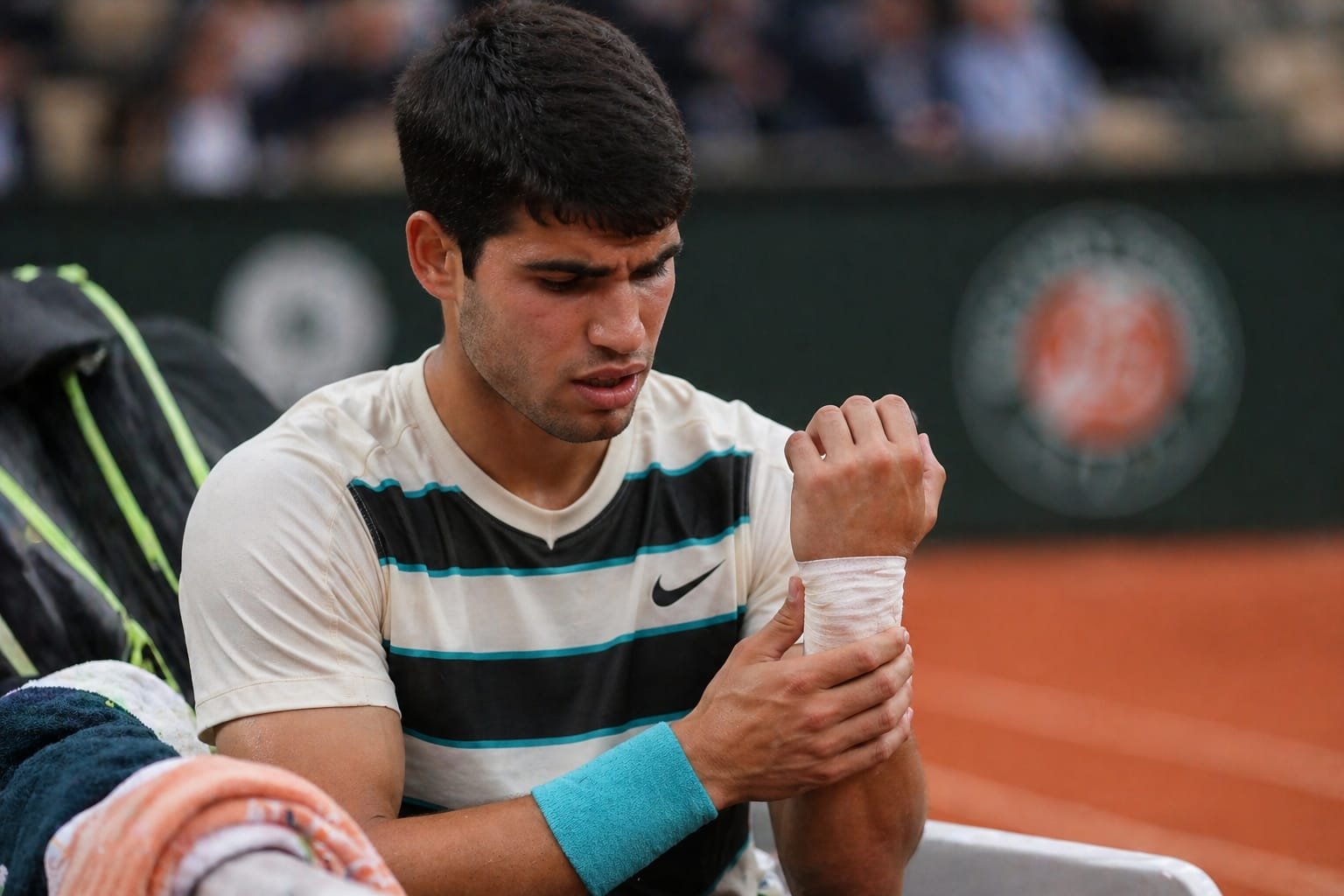
The problem surfaced during Alcaraz’s first-round match at the Barcelona Open, where he picked up a right wrist injury in the process of winning the tie. While he came through that game, the discomfort was clearly serious enough to stop him from continuing. He withdrew from the rest of the tournament before the situation was fully assessed.
The scan carried out in Madrid did not offer the reassurance his camp was hoping for. Shortly after the results came through, the 22-year-old took to Instagram to explain his decision directly to his supporters. “After the results of the tests carried out today, we have decided that the most prudent thing to do is to be cautious and not participate in Rome or Roland Garros, while we assess the situation to determine when we can return to the court,” he wrote. “This is a difficult time for me, but I am sure we will come out of this stronger.”
Those words — cautious, assess, determine when — tell you everything. There is no timeline. There is no guaranteed return date. This Carlos Alcaraz injury update leaves open far more questions than it answers.
Carlos Alcaraz Injury Update: Why Wrist Problems Are So Serious for Tennis Players
Wrist injuries sit in a particularly difficult category for professional tennis players. Unlike a muscle strain that responds well to rest, a wrist that has been stressed across years and years of striking thousands of balls is a complicated structure to manage. Former US Open champion Dominic Thiem, another player who generated enormous power from his groundstrokes, was eventually forced to retire in 2024 after his own wrist issues became impossible to overcome. That example is not lost on anyone around Alcaraz.
The stress placed on a player’s wrist is not uniform across the season, either. Different balls at different tournaments — varying in weight and how they respond off the surface — each put slightly different demands on the joint. When you add clay-court conditions, where the ball sits on the strings a fraction longer and the rallies demand more sustained physical output, the load only increases.
Alcaraz is someone who generates a significant amount of his power from his forehand. That shot, executed at the pace and frequency he plays it, puts a very specific strain on the right wrist with every swing. When that joint is already compromised, continuing to play — even for the most important events of the year — is a genuine risk rather than a calculated one.
The fact that his team is choosing caution and declining to put a return date in the public domain strongly suggests the injury is being taken seriously, not managed around.
What This Means for the Rest of the Season
To understand the scale of what Alcaraz is missing, it helps to recall what he did last clay season. He won titles in Monte Carlo, Rome, and Roland Garros — and reached the final in Barcelona. That is not a player who merely enjoys clay. That is a player who has made the surface his own.
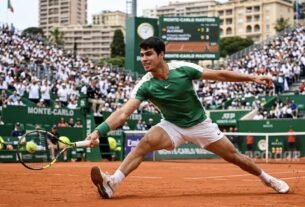
This year, the clay swing started encouragingly. He reached the Monte Carlo final, where he was beaten by Jannik Sinner, a defeat that also cost him the world number one ranking. He then went from that Sunday final to a Barcelona first-round match on the Tuesday — a schedule that in hindsight applied too much load, too quickly, to a body that was already running on a compressed timeline.
Now, he is stepping back entirely. That loss of points from Rome and Roland Garros, where he was defending a huge haul from last year, means he will drop significantly in the rankings. Sinner, currently on an excellent run, will benefit considerably from the gap that opens up.
There is a broader opportunity here too for Novak Djokovic, who turns 39 during the tournament and remains in pursuit of a record 25th Grand Slam title, and Alexander Zverev, who continues to search for his first major. Both men now have a clearer run at the title than they would have had with a fit Alcaraz in the draw.
Sinner, speaking after his win over Benjamin Bonzi at the Madrid Open, offered warm words for his great rival. He called Alcaraz “definitely the best player” on clay and said the situation was “very sad news,” while also making the point that at their age, protecting the body has to come before anything else.
You can follow more tennis coverage, including the latest on the Alcaraz-Sinner rivalry as it developed through the Monte Carlo quarter-finals, at The Dakia’s tennis section.
Eyes on Wimbledon
For anyone looking for something positive in this Carlos Alcaraz injury update, it is this: wrist injuries of this kind, when handled correctly and given proper recovery time, do not have to become long-term problems. Alcaraz is 22. He has time on his side. Sinner himself acknowledged that at their age, it makes more sense to look after the body now than to risk a far more serious setback down the line.
The youngest man to complete the career Grand Slam earlier this year by winning the Australian Open, Alcaraz’s clay season is over before it truly began. The hope, for his team and for tennis in general, is that the grass at Wimbledon — where he has been a formidable champion — gives him something to aim for and a realistic date to build his return around.
Until the scans are reviewed further and the medical picture becomes clearer, the only certainty is that Roland Garros 2026 will take place without its defending champion. And for a tournament that has been defined in recent years by the battles he has produced on that court, that is a genuinely significant absence.