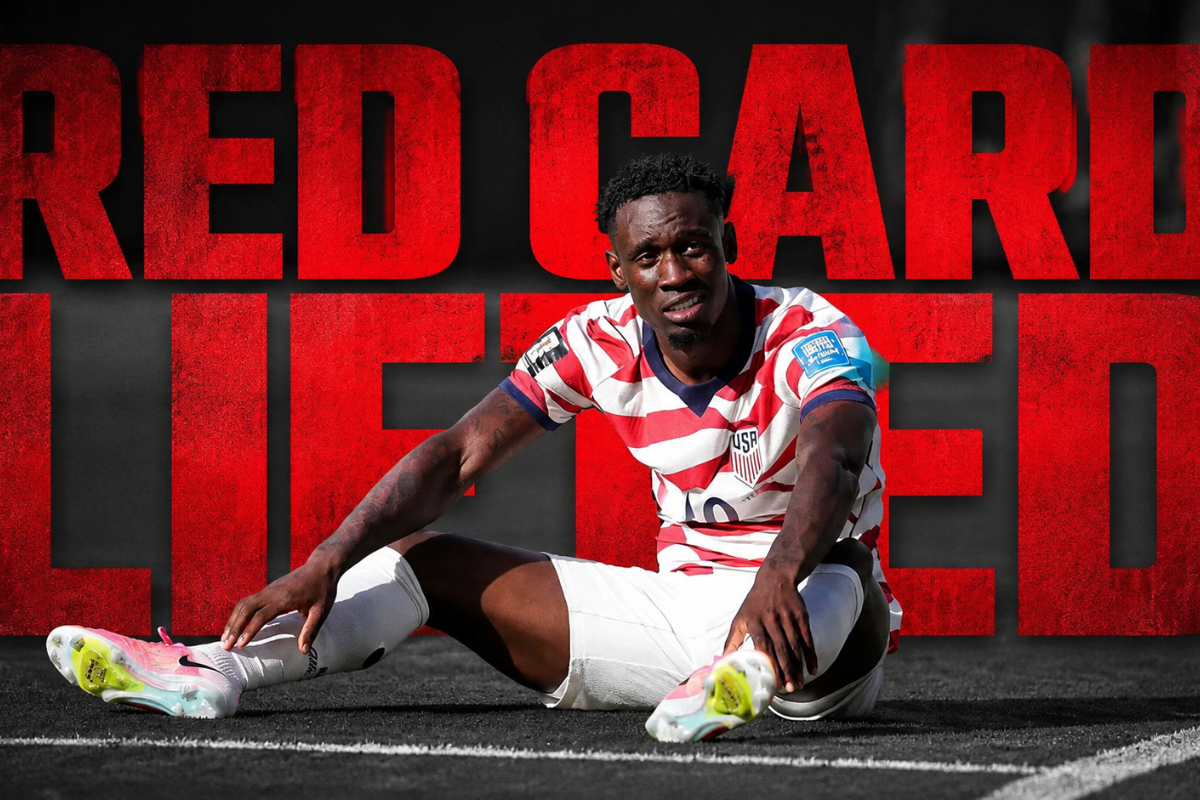
Folarin Balogun’s suspension has been lifted ahead of the USA vs Belgium Round of 16 clash at the FIFA World Cup 2026, with FIFA’s Disciplinary Committee invoking Article 27 of its own rulebook to clear the USMNT striker. Here is a full breakdown of what happened, how the Balogun suspension was lifted, and what Article 27 FIFA actually means.
USA vs Belgium round of 8 quarter-final path and World Cup 2026 bracket
(updated on July 8, 2026 after reports of Belgium appealing the decision to lift Balogun suspension)
Why the Balogun Suspension Was Lifted
FIFA has not publicly explained its reasoning beyond citing Article 27, but three factors made this decision close to inevitable.
The first is the VAR protocol problem. ESPN’s official VAR review column concluded that the video assistant used slow-motion replays to judge the intensity of Balogun’s challenge, which is not how the system is supposed to work. Under FIFA’s own VAR protocols, slow-motion should only be used to determine the point of contact, not to assess force or intent. The referee, Raphael Claus, did not even call a foul in real time.
He only went to the monitor after the VAR flagged it based on footage that made an accidental step look far more violent than it was at full speed. FOX referee analyst Mark Clattenburg said the challenge “lacked force and intensity” and should never have triggered a VAR intervention in the first place. If VAR was misapplied, the red card that followed was built on a procedural error, and that gave FIFA grounds to act.
The second factor is political pressure. U.S. Secretary of State Marco Rubio publicly said the team had been treated unfairly and urged FIFA to introduce an appeals process for red cards at the World Cup. President Donald Trump posted on Truth Social within minutes of the decision being announced, writing that FIFA had done “what was right” by “reversing a great injustice.” Whether political pressure directly influenced the Disciplinary Committee’s decision is impossible to confirm, but the timing and the volume of attention from the highest levels of the U.S. government on a host nation’s star player cannot be ignored.
ALSO READ: USA eliminated — full World Cup 2026 semi-final bracket and fixtures
Donald Trump Responds To Balogun Suspension Being Revoked
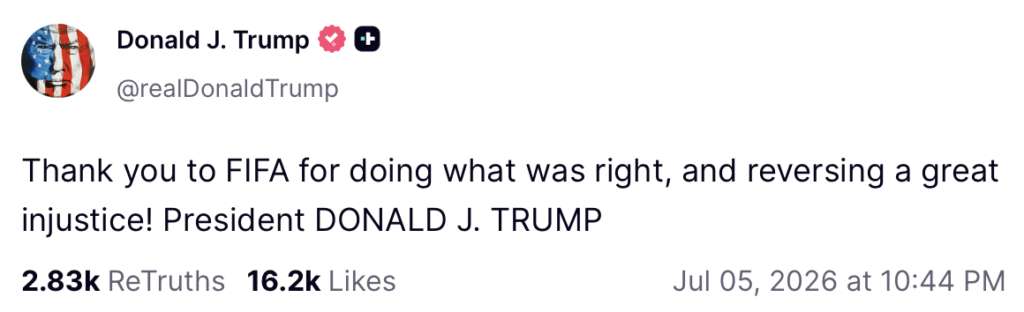
Minutes after FIFA’s now controversial announcement, USA President Donald Trump reacted to the Balogun news on Truth Social. He expressed his gratitude at the suspension being lifted and thanked FIFA for the same.
“Thank you to FIFA for doing what was right and reversing a great injustice! President DONALD J. TRUMP,” he wrote.
What Happened: The Balogun Red Card Against Bosnia
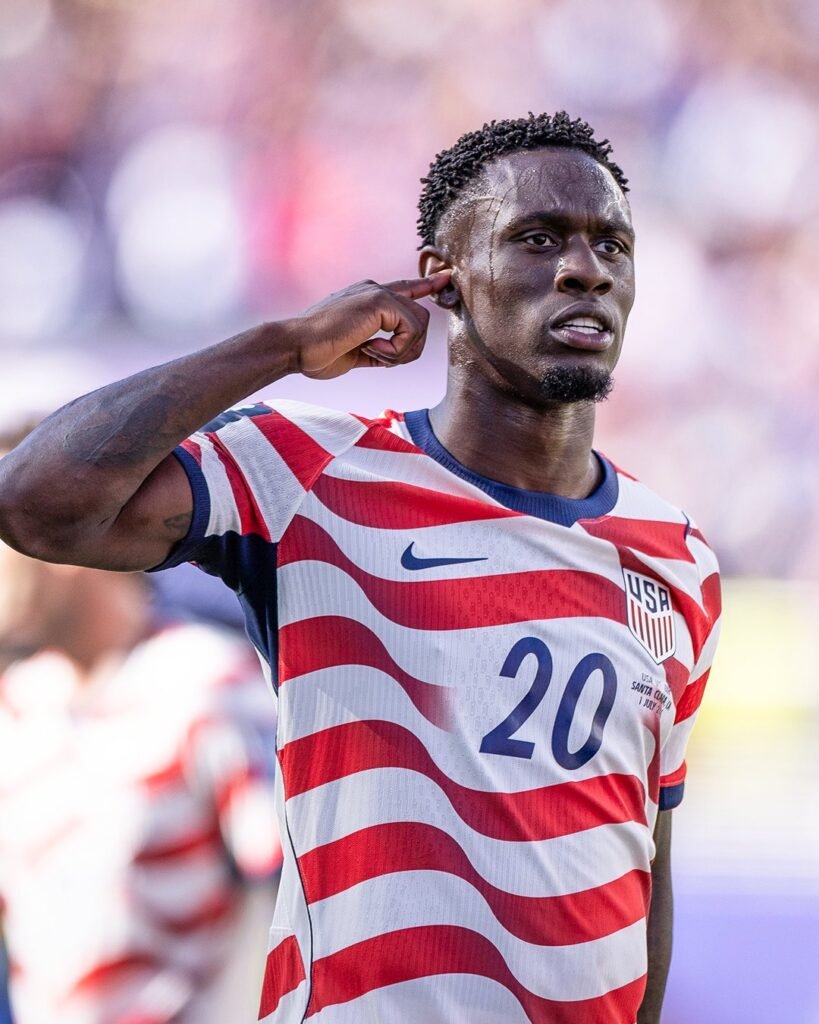
Balogun was sent off in the 64th minute of the USA’s 2-0 Round of 32 win over Bosnia and Herzegovina on July 1 at Levi’s Stadium in Santa Clara. He had already scored his third goal of the tournament in the first half.
The incident itself was unremarkable in real time. Balogun, a key player in USA World Cup 2026 squad, and Bosnia defender Tarik Muharemovic were competing for a bouncing ball when Balogun’s foot came down on the back of Muharemovic’s ankle. Brazilian referee Raphael Claus did not even award a foul at the time, only stopping play once the ball went out so the injured defender could receive treatment.
Then VAR intervened. Video assistant referee Juan Ernesto Soto Arevalo sent Claus to the pitchside monitor, where slow-motion replays made the contact look far worse than it appeared at full speed. Claus returned and showed Balogun a straight red card for serious foul play.
The decision was immediately controversial. FOX referee analyst Mark Clattenburg said on the broadcast that the incident did not meet the threshold for a red card, calling it “more of a stepping action” that “lacks force and intensity.” ESPN’s VAR review column concluded that the replays were used improperly, noting VAR protocols state slow-motion should only be used to determine point of contact, not to judge intensity. USMNT head coach Mauricio Pochettino was blunt after the match, saying there was never any intent to injure and calling it “a normal action in football.”
Under Article 10.5 of the FIFA World Cup 2026 regulations, a red card triggers an automatic one-game suspension. With no appeal mechanism available for red cards at this tournament, Balogun appeared certain to miss the Belgium match.
How the Balogun Suspension Lifted Scenario Arose
On Sunday, July 5, The Athletic first reported that Balogun had been cleared to play against Belgium. U.S. Soccer confirmed the news shortly after.
FIFA’s Disciplinary Committee reviewed the incident and decided to suspend the implementation of the one-game ban. Their official statement read: “By operation of Article 27 FDC, the implementation of the automatic match suspension for USA player Folarin Balogun is suspended for a probationary period of one year.”
U.S. Soccer responded: “We accept the decision of the Disciplinary Committee and are pleased that Folarin Balogun is eligible to compete tomorrow. Our full attention is focused on the Round of 16 match against Belgium in Seattle, and we look forward to the continued support of our amazing fans.”
The key distinction here is that the red card itself was not overturned. It still stands on Balogun’s record. What changed was the punishment attached to it. FIFA did not rescind the sending off. They suspended its consequences.
What is Article 27 in the FIFA Disciplinary Code
Article 27 of the FIFA Disciplinary Code (FDC) sits in Chapter 4, which deals with the implementation of disciplinary measures. It has four clauses.
The first clause gives FIFA’s judicial body the power to “fully or partially suspend the implementation of a disciplinary measure.” In plain terms, a punishment can be put on hold rather than enforced immediately.
The second clause sets the terms of that hold. When a sanction is suspended, the player enters a probationary period lasting between one and four years. Balogun’s probationary period has been set at one year.
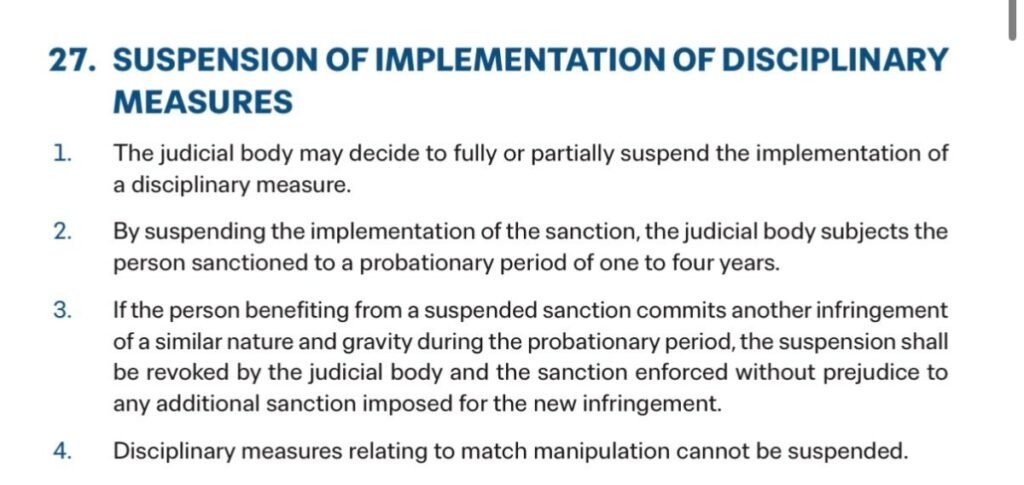
The third clause establishes the consequence of reoffending. If Balogun commits another infringement of similar nature and gravity during that probationary period, the suspended ban gets activated immediately, on top of whatever new punishment he receives for the fresh offence. So the one-game suspension does not disappear. It hangs over him for the next 12 months.
The fourth clause sets one hard limit: disciplinary measures related to match manipulation can never be suspended under Article 27 FIFA rules.
Why This is Not the Same as an Appeal
There is an important distinction between what happened here and a traditional appeal. Under FIFA World Cup 2026 regulations, teams cannot appeal red card decisions. FIFA confirmed this directly after the Bosnia match, stating there is no appeal process for on-field red card calls. U.S. Soccer also told media there was “no mechanism for appeal.”
Article 27 works differently. It does not question or reverse the referee’s on-field decision. The red card stands. What Article 27 FIFA allows is for the Disciplinary Committee to adjust how the resulting punishment is served. The committee looked at the circumstances, the nature of the foul, and likely the widespread view that VAR protocols were misapplied, and concluded that suspending the ban was appropriate.
This is why U.S. Soccer’s statement said they “accept the decision” rather than celebrating an overturned call. Balogun was cleared to play, but the card remains.
The Cristiano Ronaldo Precedent
This is not the first time Article 27 has been used to benefit a high-profile player at a convenient moment. In November 2025, Cristiano Ronaldo received a red card in Portugal’s World Cup qualifier against the Republic of Ireland for elbowing defender Dara O’Shea. The incident initially carried a three-match suspension.
Ronaldo served one match of the ban, Portugal’s final qualifier against Armenia. FIFA’s Disciplinary Committee then suspended the remaining two matches under a one-year probationary period, clearing Ronaldo to play at the 2026 World Cup. The committee cited Ronaldo’s record of 225 international appearances without a prior red card as a factor.
The Balogun case goes further than Ronaldo’s. Ronaldo served one match before the rest was suspended. Balogun’s entire one-game ban was suspended before he served any of it.
What This Means for USA vs Belgium
With the Balogun suspension lifted, Pochettino gets back his most important attacking player. Balogun leads the USMNT with three goals at this World Cup, including goals against Australia (group stage), Turkey (group stage), and Bosnia (Round of 32). No other American player has more than one.
The USA face Belgium on Monday, July 6 at Lumen Field in Seattle, with kickoff at 8 PM ET. It is a rematch of the 2014 World Cup Round of 16, which Belgium won 2-1 in extra time through goals from Kevin De Bruyne and Romelu Lukaku, both of whom remain in the Belgian squad 12 years later.
Balogun will need to be careful. Any similar offence during his one-year probationary period would not only earn a new punishment but also reactivate the suspended one-game ban. The stakes could not be higher. Can Balogun play against Belgium and deliver again, this time with a disciplinary sword hanging over him? That is the question Pochettino and the USMNT will answer in Seattle.
ALSO READ: Jordan Henderson’s wrist injury after celebration went wrong post England vs Mexico clash
For the full FIFA World Cup 2026 knockout bracket and schedule, check our Round of 32 fixtures tracker.