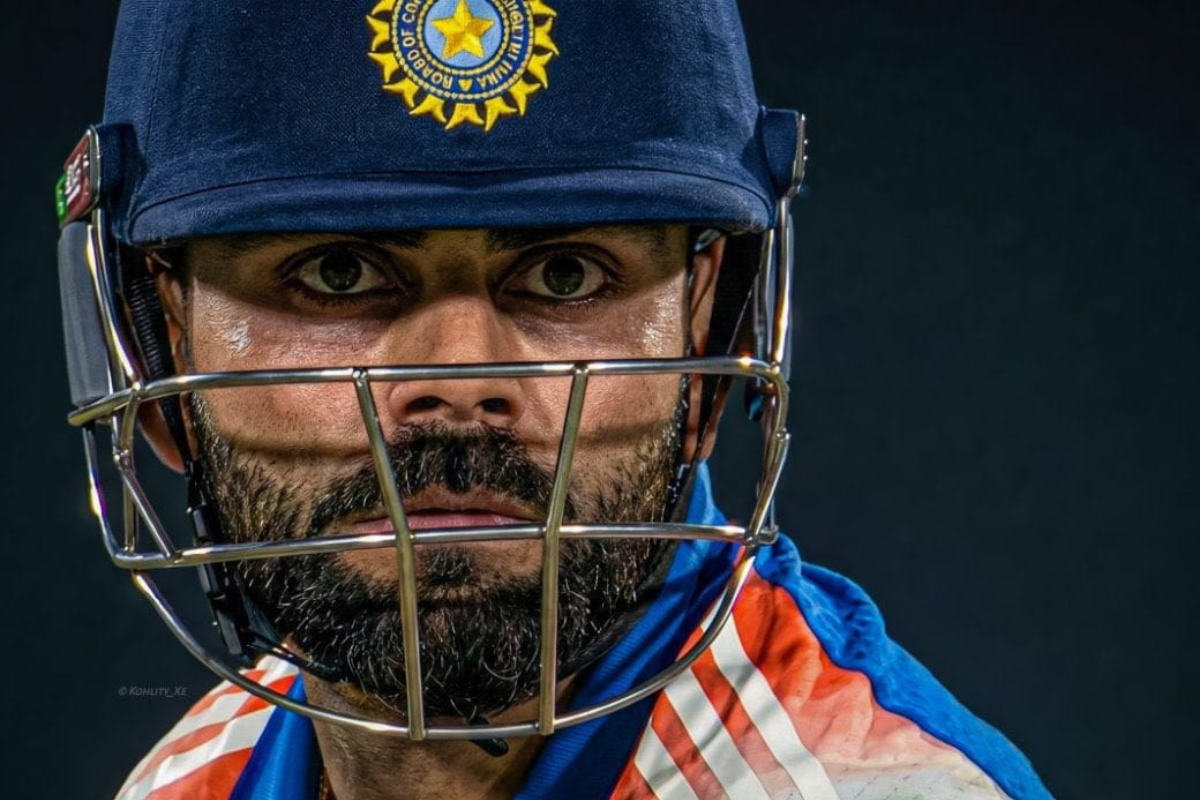
For more than a decade, Virat Kohli has been the benchmark for consistency in ODI cricket. But what has stood out in recent months is not just the volume of runs, but the way they have come. Four consecutive ODI fifties, a fluent 93 against New Zealand, and a calm authority at the crease point to something deeper than form. Kohli hasn’t reinvented himself. He has refined himself.
And that refinement didn’t begin in international colours. In the lead-up to the New Zealand series, Kohli quietly put together two high-impact List A innings for Delhi in the Vijay Hazare Trophy — a fluent 77 followed by a commanding 131. Those knocks, played with freedom and intent, set the tone for what was to follow at the international level.
Same Virat Kohli, Different Mindset
At first glance, Kohli’s innings against New Zealand looked familiar. The on-drive to get off the mark. The balance at the crease. The ability to find gaps without forcing shots. But beneath the surface, there was a noticeable change in intent.
Unlike earlier phases of his career, Kohli now looks willing to take calculated risks from the start. He is not waiting for a set phase to accelerate. The lofted shots, once reserved for the later stages of a chase, are now part of his early-innings toolkit.
And it helped in this game where the pitch got slower as the game went on. KL Rahul cited the Kohli-Gill stand as a crucial part of India’s win.
“Kohli and Gill found the right tempo, played very well so that the lower order would have an easy job. They went at a good rate so that we didn’t have to chase too many at the end”, KL Rahul said in the post match interview.”
Virat Kohli Batting Without The Weight Of Numbers
The current version of Kohli appears lighter, both mentally and in approach.
His recent run of form in List A cricket, a sequence of seven consecutive 50+ scores, reflects a batter playing without baggage. The 93 against New Zealand came at a strike rate above 100, built on controlled aggression rather than accumulation.
Virat Kohli – Last 7 List A Innings
| Runs (Balls) | Opponent | Competition |
|---|---|---|
| 93 (91) | New Zealand | ODI |
| 77 (61) | Gujarat | Vijay Hazare Trophy |
| 131 (101) | Andhra | Vijay Hazare Trophy |
| 65* (45) | South Africa | ODI |
| 102 (93) | South Africa | ODI |
| 135 (120) | South Africa | ODI |
| 74* (81) | Australia | ODI |
He made it clear that had India been batting first, he would have gone even harder. That statement alone reflects a batter liberated from personal landmarks.
One of the most telling changes is Kohli’s willingness to counterattack when situations turn tricky. As India’s No.3, he often walks in when early wickets fall or when the ball is still new. Earlier, this phase was about rebuilding. Now, it’s about regaining control.
Kohli has been clear about this role. If the situation demands it, he attacks, without playing outrageous shots, but without retreating either. It’s a fine balance, and very few batters manage it consistently.
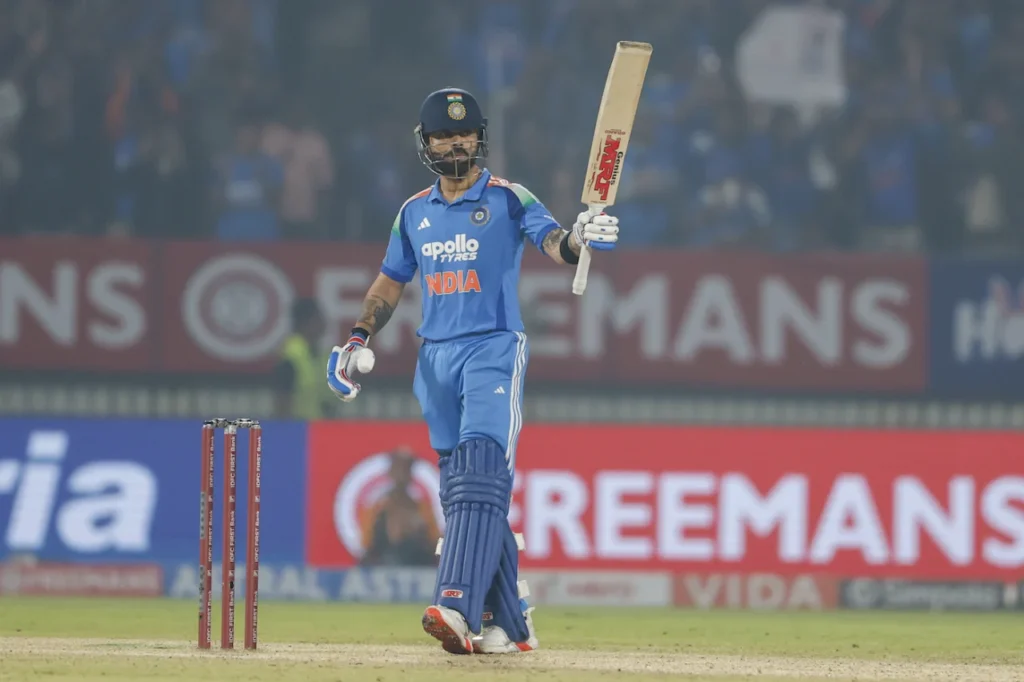
“In a chase, with a total on the board, I had to play the situation,” Kohli told Harsha Bhogle after the IND vs NZ 1st ODI. “I felt like hitting more boundaries, but experience kicks in. The only thing on my mind was getting the team into a position where we could win comfortably. (when asked what changed in his approach).”
“The basic idea is I bat at No.3, if the situation is tricky, I back myself to counterattack rather than just waiting around. Any ball can have your name on it, so there’s no point being passive. At the same time, you don’t play outrageous shots, you stick to your strengths. Today, when I walked in after Rohit got out, I felt if I pushed hard in the first 20 balls, we could put the opposition on the back foot. That ended up making the difference.”
This mindset was evident even in domestic cricket, where his Vijay Hazare hundreds were built around tempo rather than caution.
Experience Doing The Talking
At 37, Kohli is no longer proving anything to anyone. Knowing that winning positions matter more than headline numbers.
Even the crowd’s reaction — cheering his arrival after a teammate’s dismissal — reflects his stature. But Kohli’s response to that moment was telling. He acknowledged the emotion, referenced similar scenes involving MS Dhoni, and moved on. His focus remained firmly on the game.
That ability to block out noise, external or internal, has been central to this phase.
A Template For Reaching World Cup 2027
With fewer ODIs left than behind him, Kohli’s current method feels like a template rather than a phase. Bat with intent. Trust experience. Put the team first. Let the numbers follow and then the World Cup 2027 could arrive soon and Kohli would be ready yet again, as he always is.
The Virat Kohli hundreds will come again, there is little doubt about that. But even when they don’t, as in the 93 against New Zealand, Kohli’s impact is unmistakable.
This isn’t a comeback story or a reinvention arc. It’s the evolution of a great batter who understands the game, and himself, better than ever. And the path to World Cup 2027 is clearing up more than ever.