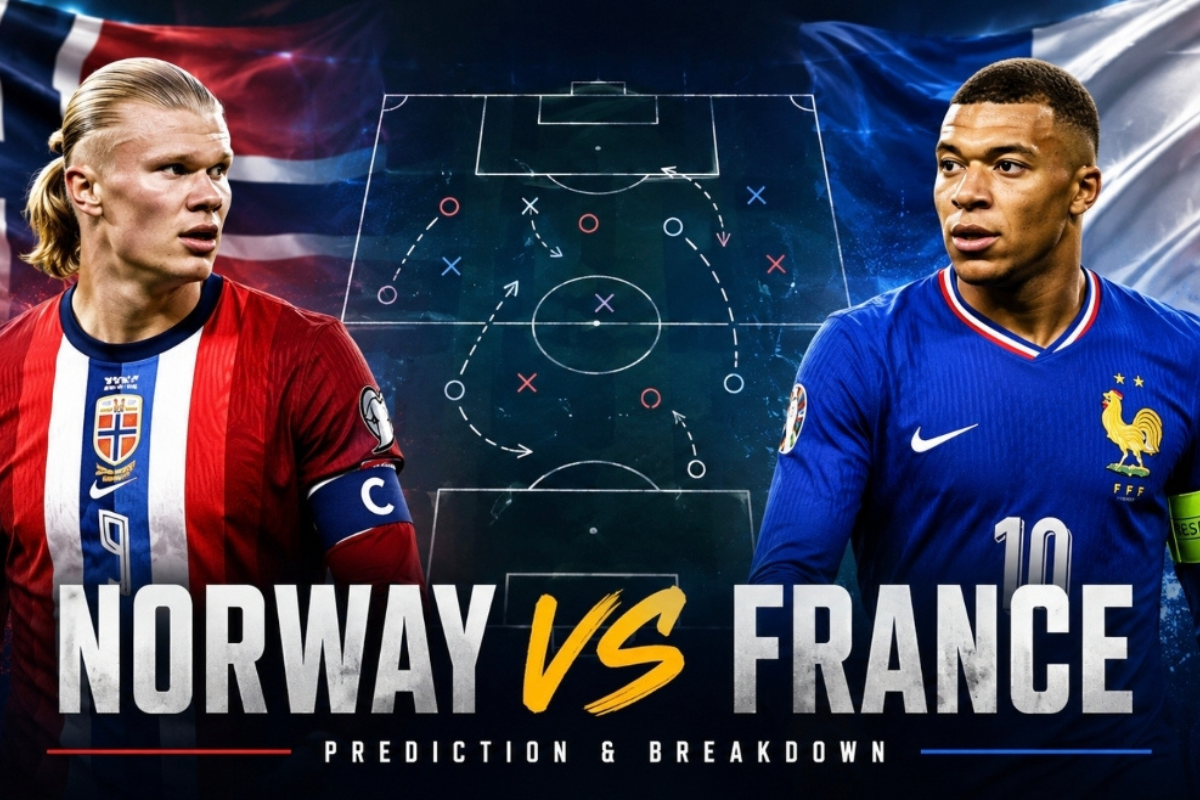
There are group-stage matches, and then there are events. The Norway vs France World Cup 2026 match at Gillette Stadium in Foxborough, Massachusetts on Friday, June 26 is the latter — the contest that has consumed search trends, dominated pre-tournament conversation, and delivered the individual duel the world actually wants to see: Erling Haaland against Kylian Mbappé, in a game that matters, on football’s biggest stage.
Both teams are already through to the round of 32. Both finished their first two fixtures with six points. But this is emphatically not a dead rubber. The winner leads Group I; the loser follows as runner-up. And in a tournament with a fixed bracket, that distinction changes everything that comes next.
France vs Norway World Cup 2026: What’s at Stake in the Group I Decider?
The stakes are structural, not existential. France and Norway have already qualified for the round of 32, but what they are playing for in Norway vs France 2026 is the shape of their entire knockout path from here.
The winner of Group I faces a third-place qualifier from Groups C, D, F, G, or H — in most projections, a team like Sweden — in the round of 32. The runner-up of Group I meets the runner-up of Group E, which is Ivory Coast. On paper, topping the group is the more manageable route: a third-place qualifier versus a group runner-up who have already beaten Ivory Coast’s opponent in a direct contest.
That difference is meaningful. In a tournament where France have realistic aspirations of going deep — Didier Deschamps has confirmed this will be his final tournament, and he has spoken about chasing a second winners’ medal — finishing second in Group I creates an additional obstacle. Norway, returning to the World Cup for the first time in 28 years and playing in front of a team whose confidence is at its peak, have every reason to chase top spot too.
Context that matters: Deschamps will not be on the touchline for this fixture. His assistant Guy Stéphan takes charge following the death of Deschamps’ mother. France’s preparation and in-game management will be handled from the bench without the manager who has steered Les Bleus through two World Cup finals.
Norway vs France Prediction: Tactical Breakdown and Key Matchups
How Norway Are Set Up
Ståle Solbakken’s 4-3-3 is designed to suffocate opponents rather than outpossess them. Norway’s high press is aggressive, coordinated and physical — they chase the ball in packs and trigger quickly when they sense a chance to win possession in the middle third.
The system has two modes. In their attacking phase, Norway’s wide midfielders push forward to create a narrow 4-1-2-3 shape, with Haaland and Alexander Sørloth as a two-pronged central threat and Antonio Nusa providing pace from the left. Martin Ødegaard, the captain, drops as a 10-and-a-half — deeper than a pure No. 10 but influential enough to link the pressure blocks between midfield and attack. Sander Berge is the defensive shield, reading the game ahead of the back four and cleaning up second balls.
Defensively, when Norway need to absorb pressure, their 4-3-3 locks into a 4-5-1 mid-block. The three midfielders hold their line, denying France access to the central corridors. The weakness is in transition — Norway have conceded in both group games, letting in three goals total, and their clean-sheet record across recent competitions has been inconsistent. Only two clean sheets in their last eleven matches is a figure France’s coaching staff will have looked at closely.
Right-back Julian Ryerson came off injured against Senegal after just 13 minutes, and his replacement Marcus Pedersen makes his first World Cup start here. That right flank is an area France can target.
How France Are Set Up
Guy Stéphan’s 4-2-3-1 is built to transition at speed and defend compactly when the ball is lost. Aurélien Tchouaméni and Adrien Rabiot form the double pivot — one covers, one presses, and between them they protect a back four that, before this match, had conceded just one goal in the group stage.
The big team-news development: William Saliba, the Arsenal centre-back who has been France’s defensive organiser throughout the tournament, is out. He missed Thursday’s training session and Maxence Lacroix of Crystal Palace comes in to partner Dayot Upamecano. That is a significant change. Saliba’s positioning, aerial dominance and ability to step into midfield under pressure were central to France’s defensive structure. Upamecano and Lacroix have not played together before at tournament level, and their communication against Haaland — who will occupy and bait the central defensive pairing with relentless movement — will be immediately tested.
Theo Hernandez at left-back is France’s engine in wide areas. He pushes high, overlaps consistently and gives Mbappé the freedom to drift inside rather than hug the touchline. That combination — Mbappé off his left foot through the channel, Hernandez overlapping to create the two-versus-one — is France’s most productive pattern.
The Key Matchups
Haaland vs the France central defence. This is the contest within the contest. Haaland has scored four World Cup goals in two appearances, and his movement — dropping deep to receive, spinning in behind, winning headers at the near post — puts enormous demands on any central defensive pairing. Without Saliba, the aerial threat at set-pieces becomes more acute. Lacroix is an able replacement, but pairing him with Upamecano against arguably the world’s most physically imposing striker in his first World Cup is a genuine challenge.
Mbappé vs Norway’s right flank. Pedersen deputising for Ryerson creates the most exploitable area on the pitch. Mbappé, who has scored four goals in two World Cup 2026 appearances, has been operating as a classic centre-forward but with the freedom to drift left and isolate full-backs one-on-one. Norway’s back four needs to maintain its shape and resist the temptation to press high, which would leave the channel for Mbappé to sprint into.
Ødegaard as the key connector. France will press aggressively when Norway build from the back, and their double pivot will look to cut off Ødegaard’s supply lines early. How well Norway’s captain finds pockets between the lines to receive and play forward will determine whether Norway can create sustained pressure or find themselves pinned back.
Midfield territory: Berge vs France’s press. Sander Berge is the most important player in Norway’s defensive phase. He has to win his individual battles in the centre of the pitch, protect the back four when France win the ball high, and still be an option to receive and switch play. France’s press — if Stéphan commits to the high-energy version — will look to isolate Berge and deny him time on the ball.
France vs Norway World Cup 2026: The Prediction
The France vs Norway prediction hinges on two variables: whether Norway’s press can unsettle a France back four that has lost Saliba, and whether Mbappé can operate at full intensity against a high defensive line. France are the more settled defensive unit and carry the attacking depth to punish a Norway side that concedes regularly. The Lacroix-for-Saliba change introduces uncertainty in France’s backline, but Norway’s best chances have come from set-pieces and direct counter-attacks — and France’s double pivot is well-equipped to limit both.
The most likely outcome is a measured France win. They have scored in every group game, conceded only once in competitive play, and carry three attackers in Mbappé, Ousmane Dembélé and Michael Olise who can each create a goal from nothing. Norway will press hard in the first 20 minutes — their pattern is to set the tempo early — but if they fall behind, Solbakken’s system will need to open up, and France have the players to hurt teams on the counter.
If Norway keep it level past the hour, Haaland becomes the decisive variable. He has scored in 18 of his last 21 competitive international games, and a match that is open and stretched will always give him opportunities.
Our Norway vs France prediction: France to win 2-1. A controlled France victory, with Haaland finding one — because he almost always finds one.
Predicted Lineups for Norway vs France
Norway Predicted Lineup (4-3-3)
Ørjan Nyland (GK) Marcus Pedersen — Torbjørn Heggem — Kristoffer Ajer — David Møller Wolfe Fredrik Aursnes — Sander Berge — Martin Ødegaard © Alexander Sørloth — Erling Haaland — Antonio Nusa
Coach: Ståle Solbakken Key absence: Julian Ryerson (injured)
France Predicted Lineup (4-2-3-1)
Mike Maignan (GK) Jules Koundé — Dayot Upamecano — Maxence Lacroix — Theo Hernandez Aurélien Tchouaméni — Adrien Rabiot Ousmane Dembélé — Michael Olise — Désiré Doué Kylian Mbappé ©
Acting coach: Guy Stéphan (Deschamps absent) Key absence: William Saliba (missed training, out)
Key Stats and Numbers for France vs Norway Today
This is the section that captures the data underpinning the France vs Norway match — the numbers that explain why this is not a straightforward result to call, even if the narrative logic points toward France.
Goals and attacking output Norway have scored seven goals in two World Cup 2026 games. France have scored six. Both are among the tournament’s most productive attacks at the group stage — but the distribution matters. Norway’s seven goals have come from four different scorers (Haaland 4, Sørloth 1, Østigård 1, Thorstvedt 1), which tells you this is not a one-man operation built entirely around Haaland. France’s six have come in even more controlled fashion: Mbappé carries four of them, with Barcola and Mbaye accounting for one each.
Goals conceded and defensive solidity France have conceded one goal in the group stage in competitive play — the 95th-minute substitute Mbaye goal from a tight angle against Senegal. Their xG against in the Senegal match was just 0.5, while France generated 1.89 — the gap in chance quality tells the real story. Norway have conceded three, and in their last 11 matches across all competitions, only two clean sheets. Against a France attack with Mbappé, Dembélé and Olise, Norway’s defensive record creates a genuine risk of conceding first.
Erling Haaland’s numbers Haaland has scored 59 goals in 52 international appearances for Norway, making him his country’s all-time leading scorer — a record he broke in October 2024 when he overtook Jørgen Juve’s tally that had stood since 1937. At this World Cup, he has already become only the sixth player to score multiple goals in each of his first two World Cup appearances. He has registered at least one goal in 18 of his last 21 competitive international games. His conversion rate inside the box, his movement to get on the near post at corners, and his ability to score from a single half-chance make him live regardless of whether France are otherwise controlling the game.
Kylian Mbappé’s numbers Mbappé became France’s all-time leading scorer during the group stage — his second goal against Senegal was his 58th for his country, moving him past Olivier Giroud’s record. He is now on 58 senior international goals. At this World Cup, he has four goals in two appearances. His 100th cap for France came in the Iraq match. The combination of his long-range threat, his movement between the lines, and his one-versus-one quality makes him arguably the most dangerous player at this tournament when he has space to run into.
Head-to-head history France and Norway have met eight times in recorded competitive and friendly fixtures. France lead the all-time series. The most recent meeting was a May 2014 friendly — a 4-0 France win that illustrated the gap between the sides at the time. This is the first occasion the two nations have met at a World Cup. Norway’s most notable result in the series came in a 2010 friendly, a 2-1 win at home. The historical record is context rather than a predictor of Foxborough on Friday, given how fundamentally both squads have transformed in the decade since they last shared a pitch.
Norway’s set-piece threat One of the most underrated elements of Norway’s attacking game is their set-piece conversion. Ødegaard and Aursnes deliver from corners and free-kicks; Haaland at the near post and Østigård arriving from deep have both already scored from this source in the tournament. With Lacroix — unfamiliar in this France defensive unit — now responsible for organising set-piece marking alongside Upamecano, Norway will target this area with intent.
The clean-sheet question In the last five matches across both squads combined, France have two clean sheets (Iraq, plus one pre-tournament) to Norway’s zero. That disparity — France keeping opponents off the board, Norway leaking regularly — is the single most significant statistical indicator for a France vs Norway match that is played at a controlled tempo.
France vs Norway Time, TV Channel, and Where to Watch
Date: Friday, June 26, 2026
Kick-off: 3:00 PM ET / 8:00 PM BST / 12:30 AM IST (June 27)
Venue: Gillette Stadium, Foxborough, Massachusetts
Referee: Michael Oliver (England)
| Region | Channel | Streaming |
|---|---|---|
| United States | FOX | Telemundo (Spanish) / Peacock / FOX One |
| United Kingdom | ITV | ITVX |
| India | Zee5 | ZEE5 Premium |
| Australia | SBS | SBS On Demand |
For a full global breakdown of where to watch every World Cup 2026 match, see The Dakia’s complete FIFA World Cup 2026 broadcasting rights guide.
Group I Table Heading Into Matchday 3
| Team | P | W | D | L | GF | GA | GD | Pts |
|---|---|---|---|---|---|---|---|---|
| France | 2 | 2 | 0 | 0 | 6 | 1 | +5 | 6 |
| Norway | 2 | 2 | 0 | 0 | 7 | 3 | +4 | 6 |
| Senegal | 2 | 0 | 0 | 2 | 2 | 5 | −3 | 0 |
| Iraq | 2 | 0 | 0 | 2 | 1 | 7 | −6 | 0 |
France lead on goal difference (+5 vs +4). A draw is enough for France to finish first.
For the full live Group I standings and round of 32 qualification scenarios across all 48 teams, see The Dakia’s FIFA World Cup 2026 qualification scenarios hub.
The Bigger Picture – Norway vs France
This Norway vs France World Cup 2026 match carries the weight of two compelling tournament stories colliding at exactly the right moment.
For France, it is the final group-stage chapter of Deschamps’ tenure — a chance to enter the knockout rounds as group winners and with momentum, even if today the touchline belongs to Guy Stéphan. The depth of France’s squad, their controlled approach in both group games, and Mbappé’s form all point to a side building toward something. Losing Saliba is a real blow, but France have covered injuries across this campaign before.
For Norway, it is something rarer: a golden generation’s first real test against elite opposition. Haaland has described what something felt “missing” throughout his club career — Champions League medals, Premier League titles, golden boots — without a major international tournament to add to the collection. Norway’s 28-year absence from the World Cup gave this group their edge; they qualified by winning every game in European qualifying, scoring 37 and conceding five. They came here with something to prove, and two wins later, the proof is substantial.
Haaland’s response to the pressure of this fixture will be one of the tournament’s most watched moments regardless of the result. When asked before the match whether he was concerned about France, he was disarmingly honest: he said France would probably beat them and might win the whole tournament. That kind of comment either reflects genuine respect or serves as the perfect psychological cover for a competitor who almost always rises when the lights are brightest.
Any Norway vs France World Cup prediction that counts France out entirely overlooks one thing: the Haaland factor. He has found the net in both group games, including against a Senegal side that is no slouch defensively, and this is the match he has waited 25 years to play in.
This is probably one of the most interesting structural mismatches of the group stage — Norway’s high-energy press against France’s transition game is a genuine tactical riddle without a settled answer. Both teams carry enough individual quality to decide games in a moment. On Friday in Foxborough, one of them will.
For The Dakia’s full FIFA World Cup 2026 coverage — group standings, round of 32 bracket, squad breakdowns and match previews — visit the football section on The Dakia.