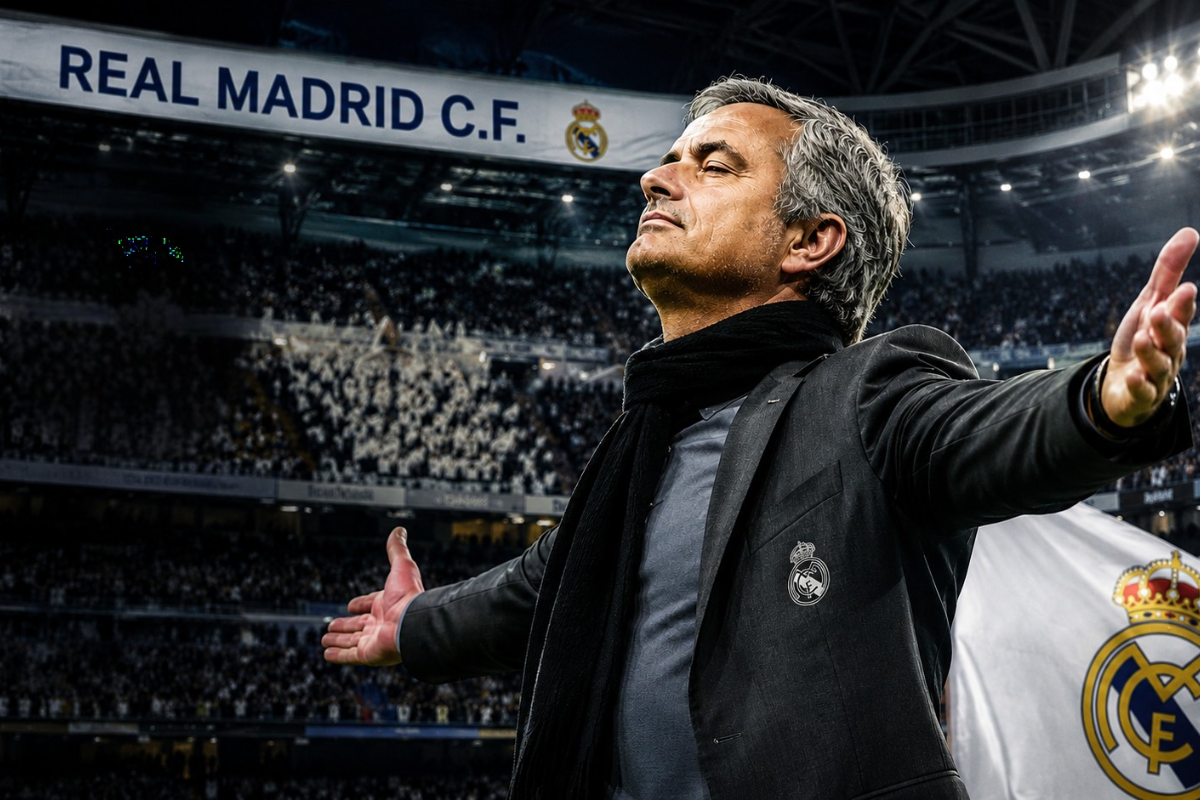
It is official. José Mourinho is back at Real Madrid. Fabrizio Romano’s “here we go” landed on May 18, 2026, confirming a two-year deal that will see the 63-year-old return to the Santiago Bernabéu 13 years after his first, turbulent, brilliant, maddening spell in the Spanish capital. Florentino Pérez has raided Benfica — triggering a €3 million exit clause — to bring back the one manager he believes can fix a dressing room in crisis and end two successive trophyless seasons. José Mourinho at Real Madrid, Chapter Two, begins now.
But before The Special One writes his next chapter, it is worth pausing to read the ones already written. Few managers in football history have had a career as wide, as dramatic, or as fiercely debated as this one. Nine clubs. Dozens of trophies. A Champions League won with two different sides. A Conference League with Roma. A very bad spell in Turkey. And a first stint at the Bernabéu that produced a record-breaking La Liga title but left wounds — some of which have never fully healed.
So, every club Mourinho has managed, ranked from worst to best.
Quick Facts: José Mourinho Manager Career
| Full name | José Mário dos Santos Mourinho Félix |
| Age | 63 (born 26 January 1963) |
| Nationality | Portuguese |
| Current club | Real Madrid (from summer 2026) |
| Total major trophies | 26 |
| Champions League titles | 2 (Porto 2004, Inter Milan 2010) |
| League titles | 8 (Portugal ×2, England ×3, Italy ×2, Spain ×1) |
| Unique record | Only manager to win all three UEFA club competitions |
José Mourinho’s Full Manager Career, Ranked
This is a ranking of every club Mourinho has managed as head coach — from the ones that diminished him to the ones that defined him.
#9 — Benfica (First Spell: Sept–Dec 2000)
Nine league games. That is all Mourinho managed before his first sacking in football management — though “sacking” is a generous word for what happened. He was appointed by outgoing president João Vale e Azevedo, inherited by new president Manuel Vilarinho, and effectively shown the door when Vilarinho refused to extend his contract after a power struggle. Mourinho, unwilling to serve at the pleasure of someone who hadn’t hired him, walked.
He won five, drew one, lost three. He left the club in third place in Liga Portugal. As short tenures go, it was not disastrous — just brutally brief, and barely enough to draw conclusions either way. Vilarinho later admitted: “I would do exactly the opposite. I would extend his contract.” An early lesson in what happens when institutions get in the way of a very particular kind of manager.
Verdict: A footnote. But every story needs a first page.
#8 — Fenerbahçe (2024–2025)
The Istanbul adventure is the most uncomfortable entry in José Mourinho’s manager career. Appointed in June 2024 to end Fenerbahçe’s decade-long wait for a Süper Lig title, he arrived to flares, chants, and 20,000 fans at the airport. He left 14 months later — sacked just six games into the 2025-26 season — having won nothing, argued with everyone, and been knocked out of the Champions League playoffs by… Benfica, the club Real Madrid subsequently raided to sign him.
It was not all bad. Across 62 matches, Mourinho won 37 — a 59.7% win rate — and he set a club record of nine consecutive home wins. But the season’s identity was shaped by controversy: a racism allegation from Galatasaray, a four-match ban for referee criticism, a nose-pinch on a rival manager that produced a three-match suspension, and the kind of entropy that seems to follow Mourinho when the trophies stop arriving.
No silverware at a major club for the first time since Tottenham. A league finished 11 points behind Galatasaray. An early Europa League exit to Rangers. Fenerbahçe ranked last in his career not because his methods failed completely, but because they failed to produce the one thing that makes everything else forgivable.
Verdict: The nearest Mourinho has come to a managerial diminishment. He needed this Real Madrid lifeline.
#7 — União de Leiria (2001–2002)
A brief, quietly impressive spell that is largely forgotten but historically important — this was the posting that got Mourinho back into the conversation in Portugal and led directly to the call from Porto. He took a mid-table side, steadied them, and left them in a good enough position in the Primeira Liga that Porto noticed. No trophies. No landmark moments. But a necessary bridge in the architecture of José Mourinho’s coaching career.
Verdict: A stepping stone, and an honest one.
#6 — Tottenham Hotspur (Nov 2019–Apr 2021)
Mourinho was hired to do at Tottenham what he had done at Chelsea and United: impose discipline, manufacture ugly wins, and deliver trophies to a club going soft on potential. It did not work. The tactics that made him revolutionary at Porto in 2003 felt fusty and reactive in the context of a Premier League shaped by Klopp and Guardiola’s pressing philosophies. Spurs won 51 of his 86 matches but never truly believed in what they were being asked to do.
The cruelest detail: Mourinho was sacked in April 2021, just six days before Spurs’ Carabao Cup final against Manchester City — the one trophy that was within reach. He never got to stand on that Wembley touchline. Whether he would have won it is academic. The image of Mourinho dismissed before a final is a strange one for a man defined by winning them.
Verdict: Wrong era, wrong club, wrong time. But he jose mourinho tottenham is more nuanced than the failure narrative allows.
#5 — AS Roma (2021–2024)
The Roma chapter was more interesting than its ending suggests. Mourinho inherited a club without recent European pedigree and, in his first season, won the Europa Conference League — making him the first and only manager to win all three major UEFA club competitions. It was historic. It was also, in the context of his career, a measure of how far the ceiling had dropped.
The second season ended in a Europa League final defeat to Sevilla on penalties — the first time Mourinho had ever lost a European final. The third season descended into dysfunction: a brutal 7-0 thrashing by Inter in January 2024, deteriorating results, and an increasingly isolated manager whose relationship with the club’s hierarchy had soured beyond repair. Sacked in January 2024.
His last major trophy, the Conference League in 2022, remains the most recent silverware in a José Mourinho manager career once defined by Champions Leagues and title races.
Verdict: Historically significant, tactically limited, ultimately sad. But that Conference League will be in the record books forever.
#4 — Manchester United (2016–2018)
He won three trophies in his first season: the Community Shield, the League Cup, the Europa League. That United became the first side in the club’s history to win the Europa League, and that Mourinho delivered it in his debut campaign, is an underrated achievement that tends to get lost in the fog of what came after.
What came after was a second season of reasonable league performance and a third of increasing bitterness — a dressing room in open revolt, a public war with Paul Pogba, and a December 2018 dismissal that felt like a relief for all parties. José Mourinho’s coaching career at Old Trafford never became what it should have been, but it produced a trophy, produced a European night, and confirmed that even a misfiring Mourinho could still manufacture moments.
Verdict: Underrated in trophy terms. Overanalysed as a personality clash. Mourinho and United were simply wrong for each other, and both knew it.
#3 — Chelsea (2004–2007 and 2013–2015)
Eight trophies across two spells. Three Premier League titles. Two League Cups. An FA Cup. A Community Shield. A body of work that stands, even now, as the most complete English chapter of José Mourinho’s manager career.
The first spell redefined what Chelsea could be. Arriving in 2004 bankrolled by Roman Abramovich, he built a team of suffocating defensive discipline and devastating counter-attacking speed. Back-to-back Premier League titles in 2004-05 and 2005-06 with a record 95 points in the first campaign. His players ran through walls. Opponents dreaded them.
The second spell, from 2013, added a third Premier League in 2014-15 and proved Mourinho could still deliver at the highest domestic level a decade after his first great success. Then it collapsed — again, in his third season, almost to the day — and he was sacked in December 2015 with Chelsea 16th in the league.
The pattern that defines Mourinho was clearest at Chelsea: the first season is usually a statement, the second is the summit, and the third is when the resentments he sows — within squads, within clubs, within himself — begin to harvest.
Verdict: José Mourinho chelsea is his most complete English legacy, and one of the finest managerial tenures the Premier League has produced.
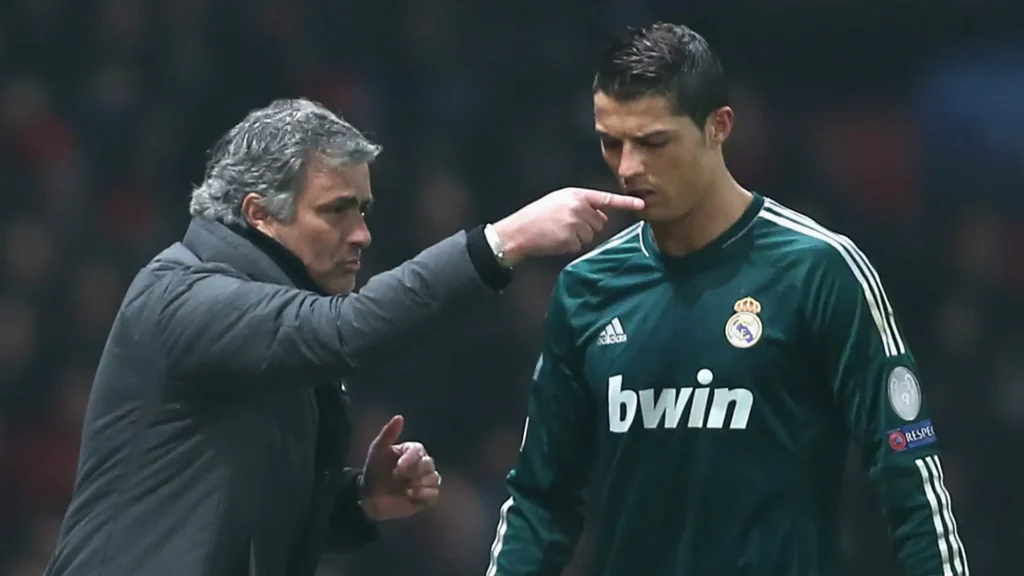
#2 — José Mourinho At Real Madrid (2010–2013)
José Mourinho at Real Madrid is where the story gets complicated — and complicated is the right word, not bad.
Mourinho was hired in the summer of 2010 to break Barcelona. He arrived having just completed the treble with Inter Milan. He left three years later with one La Liga title, one Copa del Rey, and a Super Cup. Not the haul that was expected. Not the Champions League that was craved.
But that La Liga title — the 2011-12 title — was extraordinary. Real Madrid accumulated 100 points, the record in the history of Spanish football. They scored 121 goals. Cristiano Ronaldo had a season of almost supernatural output. José Mourinho’s tactics built a team that did not merely win the league — they steamrolled it.
The Champions League remains the wound. Three semi-finals across three seasons, all lost. Barcelona in 2011. Bayern Munich in 2012. Borussia Dortmund in 2013. For a manager hired to deliver Europe, that record is the caveat on every achievement. The dressing room fractured too — his relationship with Iker Casillas deteriorated publicly, Sergio Ramos was a vocal critic, and the Spanish press treated each press conference as a theatre of hostility.
He returns now with more experience, more scar tissue, and a squad of a different generation. Whether the lessons of his first spell inform the second is the most interesting question in European football this summer.
Verdict: A record-breaking title, three European wounds, and one of football’s most fascinating implosions. José Mourinho at Real Madrid in the first stint was complicated, but never boring.
#1 — Porto (2002–2004)
This is where The Special One was born.
Mourinho took Porto in 2002, a club of regional pride but modest continental standing, and built something almost irrational. In his first full season, Porto won a domestic treble — the Primeira Liga, Taça de Portugal, and UEFA Cup. In his second, they won the Champions League, beating Monaco in the final after eliminating Manchester United and Deportivo de la Coruña along the way.
The tactics were a revelation: compact defensive structure, rapid transitions, collective press, and a clarity of identity so total that every player understood their role without being told twice. Mourinho’s principles — which would be replicated, refined, and eventually argued against across two decades of European football — were forged at Porto. The José Mourinho coaching career begins here in any meaningful sense.
He left for Chelsea the day after the Champions League final. Porto fans have never quite forgiven him. That seems about right.
Verdict: The purest version of everything Mourinho would ever be. No bigger squad. No bigger budget. Just the idea, fully realised.
José Mourinho Trophies: The Full List
| Competition | Times Won | Clubs |
|---|---|---|
| Champions League | 2 | Porto (2004), Inter Milan (2010) |
| UEFA Cup / Europa League | 2 | Porto (2003), Manchester United (2017) |
| Europa Conference League | 1 | AS Roma (2022) |
| Premier League | 3 | Chelsea (2005, 2006, 2015) |
| La Liga | 1 | Real Madrid (2012) |
| Serie A | 2 | Inter Milan (2009, 2010) |
| Primeira Liga | 2 | Porto (2003, 2004) |
| Copa del Rey | 1 | Real Madrid (2011) |
| FA Cup | 1 | Chelsea (2007) |
| Domestic Cups / Super Cups | 11 | Various clubs |
Total major trophies: 26
Only six managers in football history have won more. Mourinho is the only manager to have won all three major UEFA club competitions — the Champions League, the Europa League, and the Europa Conference League — a record that may never be matched.
What José Mourinho’s Return Means for Real Madrid
Real Madrid have gone two seasons without a major trophy. Their dressing room is, by multiple accounts, fractured — with Kylian Mbappé struggling to win the affections of the fanbase, midfield continuity elusive, and Florentino Pérez running out of options after Xabi Alonso departed and Álvaro Arbeloa failed to steady the ship. José Mourinho at Real Madrid changes all of that.
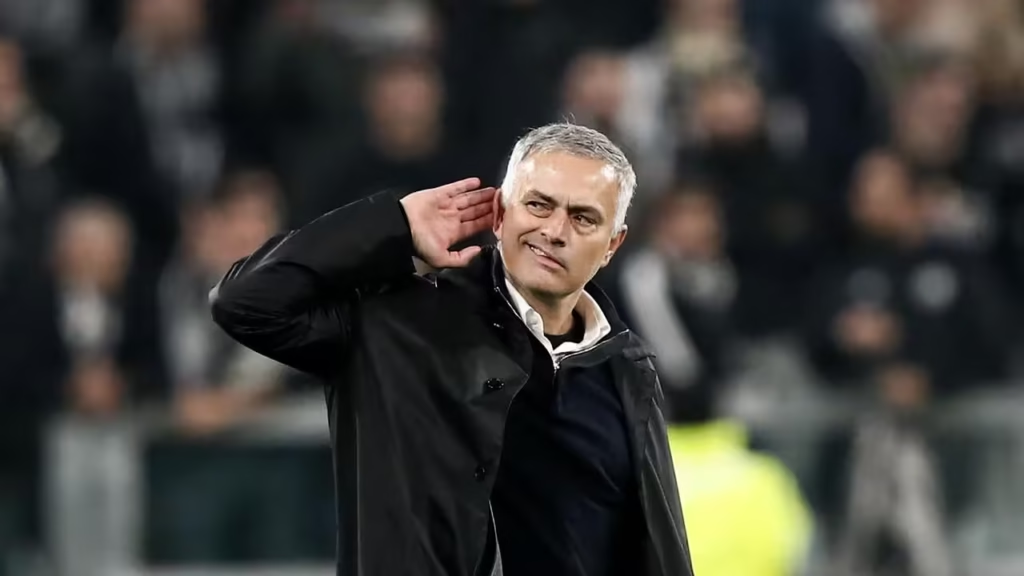
Into this walks a 63-year-old who knows the Bernabéu’s rhythms, its politics, and its pressure in ways that no external appointment could. José Mourinho at Real Madrid is not a sentimental reunion — it is Pérez making a ruthlessly calculated bet that the one thing missing from this squad is the kind of authority only Mourinho can provide.
His transfer priorities are already reported: Rodri from Manchester City as the midfield anchor, with Bernardo Silva potentially available as a free agent. The tactical shift is expected to move Madrid toward greater defensive solidity and vertical speed — away from the positional, possession-heavy shape that served them poorly last season.
Whether it works depends, as it always has with Mourinho, on the first 18 months. He rarely fails in year one. He rarely survives year three. European football will be watching very closely as José Mourinho at Real Madrid takes shape.
For a full breakdown of how the La Liga landscape looks heading into next season, see our FIFA World Cup 2026 squads hub, which tracks the key players — including Vinícius Jr and Mbappé — who will be central to Mourinho’s planning at Madrid.
Follow The Dakia for more coverage of Real Madrid, La Liga, and the FIFA World Cup 2026.