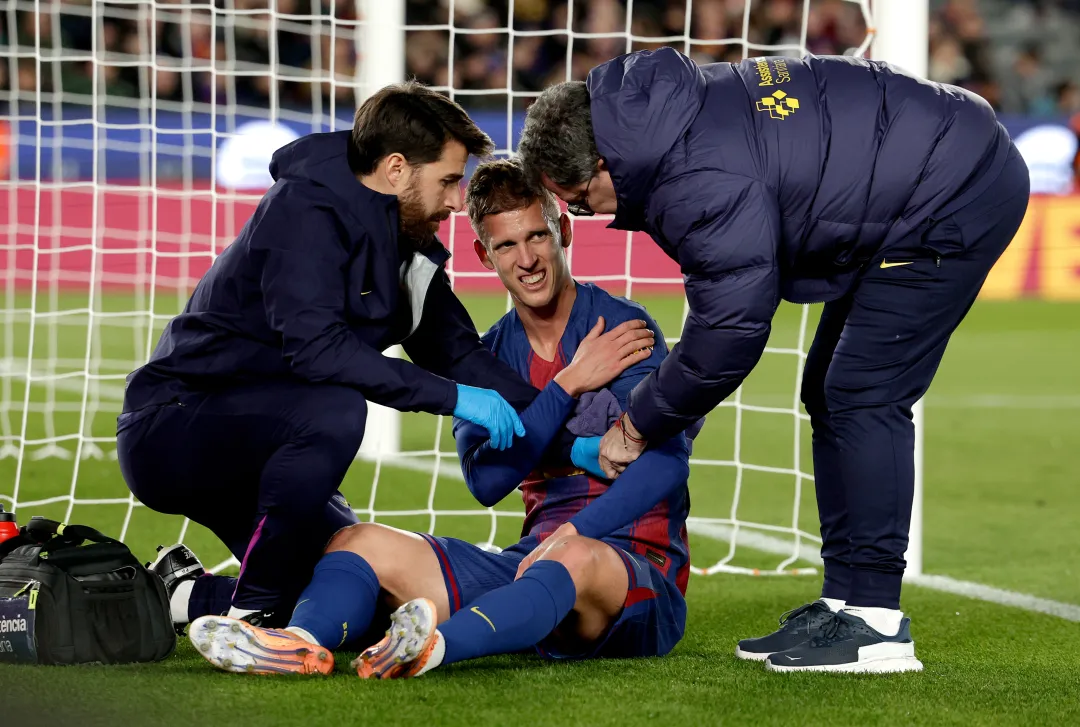
Barcelona’s preparations for a pivotal phase of the season have been shaken once again. The club confirmed on Wednesday that midfielder Dani Olmo will miss approximately a month after dislocating his left shoulder during the 3–1 win over Atletico Madrid.
The injury occurred in the very moment he scored — a fall that turned a high-impact contribution into yet another spell on the treatment table for a player whose Barcelona journey has repeatedly been interrupted by fitness problems.
The medical report released by Barca stated that a conservative treatment plan has been chosen, ruling out surgery for now, and pegging his return date at early January. But beyond the official timeline lies a broader concern: Olmo’s availability has become a recurring headline since his transfer from RB Leipzig in 2024, and another enforced absence comes at a time when Hansi Flick’s side is already navigating a growing injury list.
Barcelona Hit at the Wrong Time
Flick’s midfield options have thinned considerably. Olmo joins Fermin López, Gavi and Marc-André ter Stegen on the sidelines, stretching Barcelona’s resources ahead of a decisive Champions League clash against Eintracht Frankfurt next week. With matches arriving in quick succession across domestic and European fronts, the absence of a creative hybrid like Olmo is more than just a numerical loss.
The 27-year-old offers a rare blend of positional intelligence, ball-carrying, and vertical movement — traits Flick has leaned on to quicken Barca’s transitions and add unpredictability between the lines. His ability to drift into half-spaces, link with wingers, and release the final pass has often complemented the system even on days when Barcelona struggled for fluency elsewhere.
His goal against Atletico, which briefly overshadowed the injury itself, was a reminder of his ability to influence high-pressure games. Without him, Flick may be forced to readjust roles within the midfield: more responsibility on Pedri to create, increased minutes for Ilkay Gündoğan, and potentially a heavier workload for youngsters thrust into situations they were not expected to shoulder at this stage of the season.
Barcelona’s four-point lead at the top of La Liga provides some cushion, but the packed festive period, coupled with Champions League knockouts looming, leaves little room for further missteps.
The Wider Impact: Sharp Edges on a Smoothening Project
Hansi Flick’s first season at Barcelona has been about course-correction — restoring structure, reintroducing dynamism, and reducing the chaos that often defined the past few seasons. Injuries, however, have become the silent disruptor. Gavi’s long-term absence, Ter Stegen’s intermittent layoffs, Fermin López’s sidelining, and now Olmo’s latest setback collectively hinder the continuity the coach seeks.
Olmo’s injury also hits at a tactical sore spot. Flick has tried to build fluidity in the final third, encouraging rotations between midfield and attack. Olmo is among the few players who naturally thrive in this model, capable of functioning as an interior, a false winger, or a roaming No. 10. When absent, Barcelona lose a layer of creativity that statistics rarely capture — the disguised runs, the quick give-and-go combinations, the subtle manipulation of defensive structures.
What This Means for Dani Olmo’s Future
While no one at the club questions his talent, the recurring injuries have sparked conversations about long-term reliability. At 27, Olmo should be entering the prime of his career, yet successive physical setbacks have limited his momentum.
For the player, this latest injury is particularly frustrating. He had begun carving a more consistent role under Flick, showing sharpness, maturity, and a clearer harmony with Barca’s tactical framework. But the stop-start pattern threatens to stunt his influence and raises questions about whether Barcelona can depend on him as a core piece in the seasons to come.
From a squad-building perspective, Olmo’s fragility might influence summer decisions. Barcelona’s midfield puzzle is already complex — with Pedri’s own fitness issues, Gavi’s recovery timeline, and the club’s tight financial parameters. If Olmo cannot string together prolonged periods of availability, the club may be forced to look for reinforcements who can provide both reliability and creativity.
A Month That Will Reveal Much More For Barcelona
The initial recovery timeline is encouraging, but Barcelona’s deeper challenge is not merely waiting for players to return — it is managing the collective strain on a squad stretched thin during a crucial run of fixtures. Flick will need to re-engineer the midfield again, while Olmo begins yet another rehabilitation process, hoping this one brings stability rather than another interruption.
For club and player alike, the next few weeks will be telling: Barcelona must prove their resilience, and Olmo must hope this is the last detour on a path he has struggled to walk uninterrupted.